U.S. Coins & Currency 447
Is this an 1879 $4 Stella in copper?
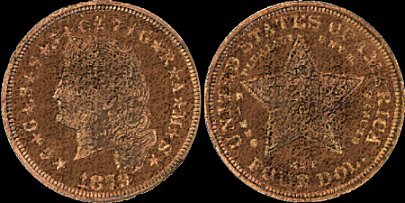
Mike H. writes: Have you ever seen this picture before? It is a supposed bronze strike pattern of a “stella” $4 piece. Someone I met thru the internet says they found it with a metal detector in Florida. Someone else says that person is lying and that the picture was stolen off of another coin site and that the person is lying that is saying they found it. Just looking for some truth. Also, if the coin were genuine pattern in bronze…what would it be worth? Thank you.
All 1879 Stellas ($4 United States gold coins) are patterns. The coin was never authorized by Congress and therefore was never a circulating medium. Stella patterns were made in gold, copper and aluminum.
All have a reeded edge. The coins were distributed to members of Congress to evaluate and most were never returned. This is the source of the pieces that still exist.
I can’t tell from the image where it was found or even if it is genuine, but the story is plausible enough. I don’t have enough auction price information do give you a current price but I would estimate the value at between $8,000 and $25,000.
1885 U.S. pattern nickel
Susan S. writes: I have an 1885 US coin with a hole in the center. On one side it says FIVE CENTS with a shield and some sort of leaves. The other side says UNITED STATES OF AMERICA with 13 stars circling the hole in the center….i have seen no reference to any of this type on this website….is it a real coin? with value?
You have a pattern 5 cent coin. Patterns are design proposals for coins. The patterns are shown to Congress which has the authority to order the minting of coins. The United States Mint has made patterns from its inception. Some designs are adopted but most are discarded. Patterns survive because those evaluating the coin often never returned it to the Mint.
The 1885 5c pattern has the following characteristics:
Obverse: UNITED STATES OF AMERICA 1885 around a circle of 13 stars within which is a hole surrounded by denticles. Reverse: Above the hole, FIVE CENTS, below the shield of the United States with a laurel branch on either side. The coin was struck in silver. It is listed in United States Pattern Coins, Experimental and Trial Pieces (the Judd reference) as J-1742.
Grade (condition) impacts value. The coin should be graded by a 3rd party grading service such as NGC or PCGS. Note that cleaning the coin will destroy much of its value. It will then be rejected by the grading services. Estimated Value: $2,000 -$7,500.+
Lacquered coins
Bill T. writes: I have a 1944 D/S lincoln cent. I sent the coin to PCGS to be graded, it was sent back in a 2 x 2 flip with two notes attached. #1- MS RD 1944-D/S 1C # 002728. On the other side it reads “# 7. Environmental Damage ie: Corrosion, Lacquer.” (There is no corrosion on the coin.) The question is – with the lacquer finish (can’t tell by looking at it) on the coin, is the coin now no good? And can the coin be cleaned without damaging the coin ? Any help would be appreciated. Thanks! Bill
Years ago, lacquering coins was a method by which to preserve the original red color of copper coins. The lacquer can be removed with acetone but requires a skilled hand. The grading services will not grade coins that are lacquered or varnished or show evidence of corrosion.
You might contact one of the Coin Grading services and see if their restoration service can successfully remove the lacquer without damaging the coin. (See the CoinSite Links page).
How many nickels laid end to end would it take to make a mile?
Trudy R. writes: Our youth group is collecting a “Mile of Nickels” as a fundraiser for 2001. I need to know how many nickels, laid end to end, it would take to make a mile. Can you help me? Thank you and I hope to hear from you soon! Trudi R., Youth Advisor Millerton Wesleyan Church
Nickels are 21.2 mm in diameter. There are 1,609,344 mm in a mile divided by 21.2 = 75,912.45 nickels laid end to end will be a mile. That is $3,795.60 in nickels.
Have fun!!
1839 City Trust and Banking Company $2 note
Jack H. writes: I have a note which reads the City Trust & Banking Company. It says it will pay two dollars to the bearer on demand nine months after Dec. 21, 1839. it also has the numbers 5509 in the top middle of the note. Is this worth looking into? Thank you.
You have a $2 note issued by the City Trust and Banking Company of New York City. The bank opened March 10, 1839 with a capital of $100,000. It closed in 1841, probably due to the Depression and upheaval caused by the closing of the Bank of the United States.
The bank issued notes in the $1, $2, $5 (two types), $50 and $100. Most of the notes were interest bearing. There may be cancellation marks or stamps on your note. Most of the notes were redeemed at par when the bank closed.
These notes are seen three ways:
- Remainders – Never issued and left over after the closing of the bank. These notes have no signatures or dates (they always were written by hand in ink).
- Cancelled/redeemed
- Never redeemed.
Value depends on the above type and condition: Estimated Range: $15 – $250.
Counterfeit early U.S. dollars
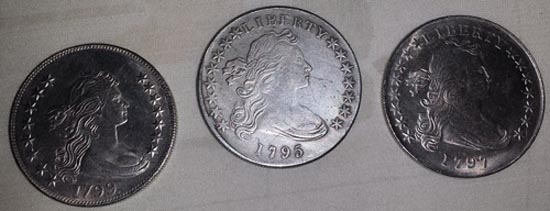
David H. writes: Here is my question: I have two Liberty US silver dollars, one is dated 1803, and one is dated 1804. Both are in possibly fine condition. Can you give me some idea of value?
Sorry to be the bearer of bad news, but it is extremely unlikely that your coins are genuine. Known as the “King of American Coins, the extreme rarity of authentic 1804 dollars makes it very tempting to counterfeiters. For well over a decade, an ever-increasing number of bogus U.S. coins have appeared in the marketplace – most of them originating in Asia and brought home by American servicemen returning from the Middle East. (See: Counterfeit Seated Liberty Dollar)
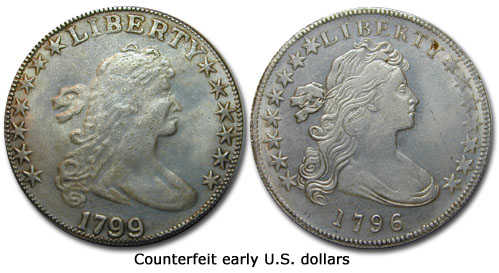
Heraldic Eagle Dollars dated 1804 are extremely rare (the last date of dollars in this period was 1803). Only 14 pieces are known (and accounted for) and volumes have been written about them. The first piece was actually struck in 1834, when dollars were not part of the coinage system, for use in a presentation set of coins given to the King of Siam. Pieces were also made for the Mint Cabinet and, years later, at the Philadelphia Mint for specific collectors. One specimen brought $3.8 millon at auction in August of 2013.
Counterfeits of this date are plentiful. Many were created in the Far East and sold to U.S. soldiers during the Vietnam War.
Authentication is mandatory. You can find certification and attribution services under Coin Grading Services on the CoinSite Links Page for more information.
You can see values for Heraldic Eagle Dollars (the 1803) on the “What’s It Worth?” feature on CoinSite.
“Fancy” serial numbers on U.S. bills
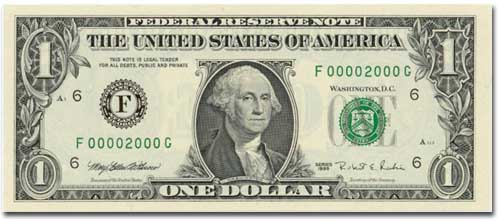
Joyce writes: My late husband used to keep US one dollar bills (and occasionally higher amounts) that had 5-7 of the same serial number in a row…..are there collectors of these bills? I have no idea what to do with them. Thank you.
Fancy serial numbers are popularly collected. Besides trying to get notes with repeating numbers, there are many other number patterns collected. There are lots of variations such as solid numbers (for examples all 2s or 1s) or “radar” notes. Radar notes have numbers that read the same frontward or backwards, like the word “radar”. Repeating patterns are also popular, i.e. 018018018 etc as well as low serial numbers or #1 notes.
You might want to make a list of the notes, their Federal Reserve bank and the serial numbers to show to a dealer who purchases currency.
Panama Canal Opening medal
John writes: I have a coin that was made specifically for commemorating the opening of the Panama canal. The date on the coin is 1913. It looks bronze in color and has a woman standing on two ships on the front of the coin. I would like to know the estimated value of a coin like this.
The official Panama Canal Opening medal was issued at the PANAMA CALIFORNIA EXPOSITION SAN DIEGO 1915. Your medal was copyrighted 1913 by J. F. Newman but the Panama canal didn’t open until August 3, 1914. The proper description is below:
Obverse: shows a boat passing though the canal, a female figure standing on the prow, long rays emanating from head and shoulders, arms are outstretched, each hand rests on a world globe representing the eastern and western hemispheres. On a ribbon across her body connecting the globes is the Latin legend OCEANI INTER SE COLUMBID CONIUNGUNTUR (Columbia Unites the Oceans). At top to left on ribbon, PROSPERITY, to the left on ribbon TO ALL NATIONS. At the lower right edge, in tiny letters is J.F.N. (the designer).
Reverse: At top, of Seal of Canal Zone; around top COMMEMORATING THE OPENING, at either side of the seal OF, THE, and below PANAMA CANAL / TO THE / COMMERCE OF THE WORLD / THIS MEDAL COPYRIGHTED AND BEARING / A SERIAL NUMBER IS ONE OF 50000 CAR/ -RIED ON THE VESSEL MAKING THE FIRST / PASSAGE THROUGH THE PANAMA CANAL / AS AUTHENTICATED IN CERTIFICATE / SIGNED BY / (written signature here) GEO. W. GOETHALS / CHIEF ENGINEER / AND CHAIRMAN/ ISTHMIAN CANAL COMMISSION. Below is the medal’s serial number, incuse on panel. Below in tiny letters copyright 1913 J.F. Newman. Bronze. Estimated value range: $100 -$200.