U.S. Coins & Currency 447
Is it a mint-made or man-made error coin?
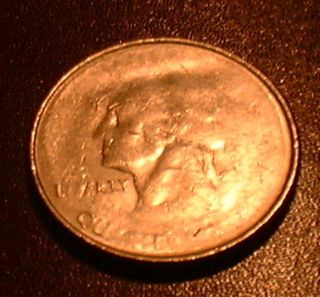
Ted G. writes: I recently acquired a “Connecticut” State Series Quarter which has had the head double struck and the heads are 180 degrees out of phase. Could you estimate the value? Would it be worth keeping (anticipate growing value) or selling? Thank you.
At first I thought this was a “brockage” error where one coin gets stuck to a die and impresses its image into the next blank. There is too much damage to the coin and it is suspiciously well lined up.
My opinion:
- two blocks of wood
- 2 quarters
- a hammer
Place coins facing each other between wood blocks. Whack with hammer until done. Viola! One “Mint” error.
There is a great deal of interest in State quarters, especially errors. It has reached hysterical levels. Normal business strikes that should be in circulation are being slabbed and sold for breathtaking prices. Hey guys, this is pocket change!
State quarter errors are bringing 10 to 20 times what scarcer earlier same type errors are bringing. Fake errors are easy to sell as the bulk of collectors for State quarters are “newbies” and don’t know the difference, thus the run on blocks of wood and hammers. I wouldn’t want to be the guy without the chair when the music stops.
The mint makes great proof and mint sets that you can buy at reasonable prices to keep your State quarter collection up to date. They are in gem condition. You can break those out and slab them if you wish. The grading services are smiling like Cheshire cats. It is their dream come true. The public is willing to slab their change at $15-$30 a pop. It’s better than bottled water.
Facts about the minting of U.S. coins
Brian asks: How much does it cost the mint to produce the cent, nickel, dime, quarter, half dollar, and dollar? Also, where can I get detailed information on the coining process? The U.S Mint website doesn’t go into detail at all. Another question, does the mint make a new master hub for each coin every year? If not, then how do they change the year on the coin? One more question, where can I find the mintage figures for all types of U.S. coins?
- The cost of producing coins varies with metal values, cost of machinery and labor. Seignorage, or the profit on minting coins increased enormously when precious metal was eliminated from circulating coinage. Today, the U.S. Mint loses money in the production of cents and nickels, but makes a profit on all the other denominations it produces. Current costs for the cent are 1.8 cents each, the nickel, 9.4 cents, the dime, 4.6 cents, and the quarter, 11 cents. Since the change in composition of the cent in 1982, Mint officials feel they’ve reached the limit of cost savings for that denomination but they continue to pursue a substitute for nickel in the five cent piece.
- A good source for information on the coinage process and its history is:
U.S. Mint and Coinage by Don Taxay.
Sanford Durst Numismatic Publications, New York - In the 19th century dates and mint marks were stamped into the working dies by hand allowing for the same hub to be used for a number of years (that’s why there are so many date varieties). In modern times the date is on the master hub requiring a new hub each year. Technology has made this cost effective. Very recently the mint mark has also become part of the master hub (I guess no more mint mark varieties either).
- You can get the mintage figures for each coin, year and mint mark by purchasing the very useful and inexpensive A Guide Book of United States Coins 2014: The Official Red Book
.

Why does the “Red Book” disagree with the “Black Book”?
Jim B. writes: In the Red Book, it says the 1841-O $5 Gold Piece is not known an any collections, while the Black book says two specimens are known. Why are there 2 different reports? Which is right? And if the Red book is right, why would the Black book say there is 2 specimens? Please Help..Thanks.
There were 50 struck. There has never been a report of someone actually finding them in a collection. The Black book speculates that 2 may have been seen (like the Loch Ness monster).
My dollar bill has a blank back
Richard P. writes: I have a 1974 one dollar bill that is blank on the back. Its serial number is L47772458G. I understand that blank backs are rarer than blank fronts and that the occurrence of the misprints is key to determining its value. Is this particular date/series worth anything substantial?
Blank backs, that is, notes missing the first printing are scarce. It can happen when two sheets are stuck together and pass through the press at the same time, a sheet could be folded over before it is printed, there was no ink on the plate or the sheets missed the printing completely because the sheet(s) was accidentally stacked in drying room instead of being printed. Value depends on grade (condition). Approximate range: $35 -$200.
1994 Women Veterans Silver Dollar
John K. writes: Hey doc, My girlfriend has a coin minted in 1994 that says “women in military service memorial.” It has busts of 5 women and all the names of the services around the edge on the front. On the back it has a pic of some memorial building and it says one dollar on it. She recieved it from her grandfather who has passed on. Can you help me out with any info on it and it’s current market price? thanks.
The 1994 Women Veterans Silver Dollar is an official United States commemorative coin struck by the Philadelphia Mint. There are two types: Mint State and Proof (“S” mint mark). The value quote assumes that the coin is still in the original box and casing and contains the certificate that accompanied the coin from the U.S. Mint. Approximate value, Mint State or Proof: $30-$35.
How do you tell the difference between the large and small motto 2c piece?
Bess B. writes: My father-in-law found an 1864 two cent piece in an old house in Ellicott City, MD. We would like to know how to tell the difference between the large and small motto since they look so similar. The coin looks in good condition but a little dirty. What do you recommend that we clean it with? Sincerely, Bess
Below are the design differences between 1864 2c, small and large motto varieties:
Small motto: The first “T” in trust is virtually up against the ribbon crease.
Large motto: There is a 1 mm gap on the large motto variety.
Small motto: The letters in the word “WE” are close together
Large motto: The letters in the word “WE” are widely separated.
Small motto: Stem to the leaf is plainly visible
Large motto: No stem
Cleaning the coin will destroy most of the coin’s value.
Value range: Small motto $30 – $500 (G4 – MS60), Large Motto: $5 – $65 (G4 – MS60).
A dishonest dealer switched my coin for a lower grade one
L.S. writes: I need some advice or assistance. I had a MS+++/proof 1867 shield nickel, (no rays). I turned it over to a local coin dealer to have it sent in for grading. I live in Mitchell South Dakota. He suggested that he do me a favor by sending it in for grading. I trusted him. I went away on vacation for two and a half months.
When I came back he gave me back a very bad xf nickel with corrosion and serious dings. Mine was beautiful, gold toned, with full luster and not even the tiniest bag mark. We both looked it over with a ten power when I handed it over. He remarked on the toning and the fact of no marks what-so-ever. Yet he told the police that I had given him a low quality coin.
How can I find out if this coin has been put on the market? I just want to know if you know of anybody that has sold or bought such a coin recently. Or how I can get more information. I gave him the coin in early April. Are there any lists or means of looking. I have been collecting for over 40 years and have never seen a better condition circulation coin. I bought it from a dealer in Germany about ten years ago.
I would appreciate any assistance or advice that you can give me. The police have told me that it is his word against mine. However, the dealer told the police that I gave him a low grade coin. So if I can trace a high grade shield nickel back to this guy I would have him cold. Please help me police our hobby.
—————-
Proof is not a grade but a method of manufacturing a special coin for collectors or presentation. This is quite a bit different that an MS (Mint State) coin that was minted for use in commerce. Only 600 1867 “No Rays” Shield nickel proofs were struck but 28,890,500 business strikes were minted.
The dealer’s argument will be that if you are confused over the type and grade of the coin that you have then you can’t take the dealer to task. If you are not experienced enough to have known whether your coin is proof or mint state then the dealer can make the argument that you certainly can’t tell the difference between circulated and mint state grades.
I have no doubt that the dealer has been dishonest but you will have to have some evidence of the condition of the coin that you submitted. Do you have a receipt with a description from the purchase of the nickel? Even if you don’t, here are some things to try:
- If the nickel you brought in to be graded was a circulated low grade coin then an ethical dealer would have advised you NOT to have it graded. Average circulated 1867 “No Rays” Shield nickels are worth from approximately $5 – $20, less than the cost of professional grading. Only uncirculated pieces or proofs without damage are worth grading this particular coin and date. (Values for mint state 1867 “No Rays” Shield nickels ($100 -$500+ and proofs: $250+). I would make this argument to the local police.
- Virtually every dealer belongs to the American Numismatic Association. They are a non-profit, educational institution chartered by The United States Congress more than a century ago. Write, email or call them for assistance. They will help you make a case and can mediate on your behalf. Being expelled from the ANA is not exactly good for business. If this individual is not a member, than you really went to the wrong place.
- You can also speak to the local District Attorney or county clerks office about the possibility of filing a criminal and/or civil complaint. The burden of proof may be satisfied by the above argument.
Sorry you had a problem. Collecting coins is suppose to be fun and sometimes even profitable.
1861 George Washington medal
Sue F. writes: I have a medal that has George Washington on the front and it says “THE CONSTITUTION IS SACREDLY OBLIGATORY ON ALL” On the back it says: U.S. MINT OATH OF ALLEGIANCE TAKEN BY THE OFFICERS AND WORKMEN SEPT. 9 1861 JAS. POLLOCK DIR. It’s around the size of a quarter. Is this a rare medal, how many were made and what approximately is it’s value? I’d appreciate any information you have.
This medal took advantage of the extreme popularity of Washington medals during the first months of the Civil War. This medal and another, with a special reverse with only a plain wreath enclosing an open space, were sold to the public until 1865. The latter were used as marksmanship prizes by the Philadelphia Rifle Club.
The medal is 31mm in diameter and they were struck in gold, silver, copper and aluminum. Anthony C. Paquet was the designer.
In 1861 only one gold example were made, 51 silver and 250 copper. An aluminum piece (alumininum was considered a precious metal in this era) may be unique. Only the copper pieces are generally available in the market and exist in much larger numbers than indicated by the initial minting. Approximate Value Range: $50 – $75+.