U.S. Coins & Currency 447
1882 Pennsylvania Bicentennial Medal
Chris F. writes: I have a commemorative coin of Pennsylvania’s bicentennial dated 1882 made by US mint. Is their a way to find a value of this?
There are three design versions of the U.S. Mint struck 1882 Pennsylvania Bicentennial Medal (the first two are 38 mm in diameter and were struck in brass). The most common is 25 mm in diameter features a facing bust of William Penn 1682 around. The later were minted in gold, silver, copper and brass. The majority were struck in brass and were made for distribution, primarily at the parade on October 24,1882.
A total of 75,000 medals were distributed. Mint made bronzed copper pieces were struck later for collectors and may still be available from the Philadelphia Mint Medal catalog. Only two gold and one hundred silver medals were minted.
Estimated value range for original examples: $35 -$50. Modern Mint struck reproductions: $2-$5.
“Rebate” token
Sally J. writes: Please give me some info on this coin – it is a coin from Goldfield Nevada. On the back side is printed Rebate Chick 2 1/2 cents (cents not spelled out) and The Den W.A. Schabe Prop. On the front it looks like a pic. of Geo. Washington. The coin appears to be made of brass.
You have what collectors call a “Store Card”. These were tokens that were good for merchandise or had monetary value at the place that issued the token. The “rebate” token was a motivation for the customer to return and use his token against future purchases. Store Cards were used at various times in American History, sometimes to take the place of coins when they were in short supply during depression (1830 -1840’s), Civil War (1861-65) or for simply for advertising purposes.
Token salesman from foundries or private mints sold tokens to the store owner with his name on one side and a standard reverse on the other. Standard reverses might have been chosen from a book of designs. Washington was a popular choice. I think this might be 20th century token. Rough estimate of value: $10-$35.
Miniature U.S. coins
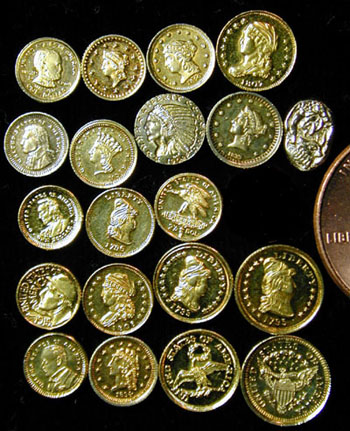
Ellen Y. writes: I have three miniature U.S Coins. One is a Mercury dime, one is a Walking Liberty half dollar and the third is a Morgan dollar. Do you know anything about these were they maybe Franklin mint coins or something?
Miniature replica coins were used as a novelty item to emphasize the inflation problem in the late 1970’s and early 1980’s. They were contained in a pouch with a miniature replica cent, nickel, dime, quarter, half dollar and dollar. Other versions had minature replicas of United States gold coins as well. (See image to right).
1902 $10 – First National Bank of Shreveport, Louisiana
Phyllis W. writes: I have a $10 bill that says National Currency on the front, and under that it says secured by United States Bonds deposited with the treasurer of the United States of America. Then, in the middle of the bill it says The First National Bank of Shreveport. Under that it says, will pay to the bearer on demand ten dollars, Shreveport, Louisiana, November 3, 1906. In the top right hand corner it has anumber 131752 and under that it says Series of 1902. There is the letter “N” just off to the side of that. It also has the number 3595 stamped on it two times. There is a picture of a man and under his picture his name “William McKinley”. What is it? Currency or some type of bond? Is it worth anything?
You have a United States, National Currency Note issued by the First National Bank of Shreveport, Louisiana, charter number 3595. Based on the serial number, your note is “Third Charter, Plain Back, Blue seal (the 1902 series ran from 1902-1908).
The First National Bank of Shreveport was chartered on December 3, 1886 with capitol of $200,000. It was absorbed into the City National Bank of Shreveport (charter number 10870). It was later absorbed by other local banks and finally, in 1930, with The American National Bank of Shreveport (charter number 8440). This bank was placed in receivership on April 19, 1935 due to lack of sufficient assets (a casualty of the Depression).
The National Bank System was started after the Civil War to stabilize the economic system and to guarantee the redeemability of currency. The National Banking System ended in 1929. Note that these notes are still legal tender for face value but their collector value is far higher. Value depends on grade (condition). Approximate value range: $50 – $400.
For additional information see: National Currency.
1775 Colonial Pennsylvania note
Mike K. writes: I have a 40 shilling bill of credit issued in Pennsylvania on 07/20/1775. I am trying to find out how many were printed, if there is anything unique about this issue, and approximate value. Thanks in advance for your help.
This is a late Colonial Pennsylvania issue. This note was a the second issue for the “Jail and Correctional Institution Construction”. Original notes are printed in black on paper with mica flakes and blue fibers. They were printed with plate letter “A” (Pensilvania) or “B” (Pensylvania) by Hall and Sellers. The number printed is unknown.
These notes are frequently found in the colonial paper money market and sell between $25 and $100+ depending on grade (condition).
Why was the Susan B. Anthony dollar round instead of multi-sided as proposed?
Ed. R. writes: I remember reading ‘Coinage’ magazine at the time the Susan B. Anthony coin had just been released. In this one issue were photos of proposed coins for the new dollar. As I remember it, the proposed coin had multiple sides. The obverse image was a rendering of “Liberty” and not S.B.A. My question is why did they use Susan B. Anthony and on a round coin instead of one with multiple sides? I thought the different edges were so that people could easily discern the difference between the SBA and quarters. Also, if the coin wasn’t popular, why did they strike more coins in 1999?
The reason for the round instead of multi-sided coin was because of problems that the vending machine industry had in developing a mechanism to accept such a coin. The Feminist movement was responsible for having Susan B. Anthony’s portrait instead of the allegorical head of Liberty. The SBA dollar was also minted in the prescribed clad sandwich as the dime, quarter and half dollar. Though the edge is round, the SBA dollar has a multisided rim. This was a consideration for the blind.
Though there certainly were “too many cooks”, the chief reason for the coin’s failure as a circulating medium probably lies in the fact that Americans do not want to give up the paper dollar. I don’t think the size, shape, color or who is portrayed on the coin has any bearing at all.
Actually, the SBA dollar was quite successful, not as main-stream money, but as a token. Many municipalities in the United States adopted the SBA as a transportation token. ‘A great idea, considering the cost saving of not having to make ones own token. The coin was also heavily used in Postal vending machines (all the change was in SBA dollars) and in private vending machines.
The coin was so successful as a token, that by 1999 the U.S. Treasury was almost out of their vast supply of 1979 and 1980 SBA’s. Since the new dollar couldn’t be minted until 2000, another run of SBA’s was minted to enhance the supply.
Note that SBA’s have not been withdrawn nor are they obsolete. They are exactly the same weight and size as the Sacagawea Dollar and later dollars and they are interchangeable in vending machines and turnstiles. In fact, the challenge was to make a different looking coin with exactly the same weight (8.1 grams) and electrical characteristics as the SBA dollar. The resulting coin is not a clad piece at all but an alloy of Manganese-Brass (88.5% Cu, 6% Zn, 3.5% Mn, 2% Ni).
What does “average grade range,” “unc,” and “unc star” mean?
Brenna P. writes: I am hoping that you can explain to me what “average grade range,” “unc,” and “unc star” mean. We just found several old paper bills and were trying to find out if they are worth anything but we don’t understand those phrases. Please help! Thank you.
Collectors buy and sell notes based on their rarity and condition. There is a grading system that describes the condition of particular notes quite accurately but common notes that have been in circulation, that is, have folds, bends, might be slightly soiled or even have a minor tear are sometimes lumped together under the heading of “Average Circulated”.
Notes that are Uncirculated, that is, considered in new condition, have four sharp corners, no folds or bends, have the original sizing in the paper and have no evidence of being handled.
In the manufacture of U.S. paper money, sheets that are damaged or destroyed are replaced with specially prepared sheets. Each note in the replacement sheet has a star next to the serial number to signify that it is a replacement for a missing sequence number. Star notes are scarcer than regular notes and, in many cases, bring a higher price than comparable regular notes.
What’s the difference in price if my coin collections are complete?
Mark S. writes: Years ago I found and purchased four Whitman coin collection books; Indian Head Cent 1856-1909, Buffalo Nickel 1913-1938, Jefferson Nickel 1938-1961 and Lincoln Head Cent 1941 to current. Some of these books still have some holes unfilled. I want to sell them but I have no idea what they’re worth. What’s the difference in price if my coin collections are complete or not?
Because of the effort in accumulating every date and mint, complete sets are usually worth more than the sum of their parts. Prices are also based on grade (condition). Someone purchasing these sets would look first to the key dates.
For example, circulated Indian cents from the 1880’s might only bring a dollar or so but even a low grade 1856 Flying Eagle would bring more than $3,000. An 1877 Indian cent, the key date of the series, can bring $500 and a great deal more depending on grade. Lesser keys from the 1870’s and coins such as the 1909-S Indian would bring hundreds of dollars.
A set of Buffalo nickels also has great potential, again, depending on grade. A key date such as the 1913-S Var 2 or 1913-D Var 2 (buffalo is standing on a line instead of a mound) can bring $100 or more in average circulated condition.
Though Jeffersons have a few weak keys, there are varieties that do bring a substantial sum. Lincolns from 1941 are essentially face value but if they are uncirculated, each coin can be worth from $1 to $10 each.
You can also see prices for common date U.S. coins on the What’s it Worth? feature on CoinSite.
You might want this potentially valuable collection appraised by a trained numismatist who could advise you on how to dispose of the most valuable pieces. Some coins do better at auction but some of the lesser pieces could be sold to a local coin dealer.