U.S. Coins & Currency 447
1862 Confederate State of North Carolina $3 bill
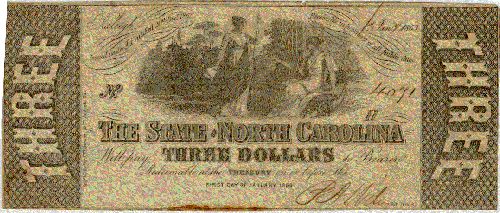
Donnie S. writes: My wife has a Confederate NC $3.00 bill. It says issued on one side Raleigh 12/20/1862 on the other corner received in payment 1/4/1863. It is signed in what appears to be red ink. The bill seems to be printed in a reddish/brown/gray ink hard to describe. Her father had it, it has been wrapped up in wax paper for over 40 years in her possession. How can we tell if it is real & what value? The material it is printed on is very thin can almost see through it. Appears to be in excellent shape some wear on edges. There is nothing printed on the back. Thanks.
From your scan I would say that your note is genuine. The note central theme shows an allegorical Liberty standing and Ceres seated. Plate letters for these notes are from A to H.
Your note grades fine or bit better. There are a few edge nicks at top and rust stains at bottom. These notes were interest bearing and would have been redeemable in January of 1866.
Unfortunately, The Confederate States of America ceased to exist after 1865 and the notes were never redeemed. Many people kept these and other notes hoping that some day “The South Would Rise Again”. Maybe, but right now collectors and dealers will redeem your note for between $10 and $15.
Did a shipment of 1907 Denver Mint dimes go off a cliff?
John T. writes: In a recent periodical there was an article related to a large shipment of 1907-D dimes from the Denver Mint that was lost in that same year after the vehicle carrying the load careened off of a cliff. These have never been found. Any advice on where I might find additional information on this most facinating occurrance? Thank You, JT
As the story goes, 4 wagonloads of dimes were lost in the Black Canyon fresh from the Denver Mint. No one knows if this is the reason that Mint State 1907-D dimes are difficult to find. Ed Rochette published an article about this story in Numismatic News some years ago. You can contact them and see if a reprint is available.
Has a $1 millon dollar bill ever been printed?
Charles Q. asks: Has a $1,000,000 single bill ever been printed? And if so, what would such a bill be worth to a collector?
The highest denomination note ever printed in the United States is the 1934 $100,000 gold certificate. This note was not meant for general circulation but for transactions between Federal Reserve Banks. None are available to collectors, though the Bureau of Engraving and Printing displays a spectacular sheet of these notes at many major coin shows.
What mints struck Morgan dollars and where do I find the mint mark?
Silver B. What mints struck Morgan silver dollars 1879-1922 and where do I find the mint mark? Thank you.
Morgan dollars were minted from 1878 to 1904 and then briefly again, with a modified design, in 1921. The design was replaced by the Peace Dollar in December of 1921. Mint Mark’s on Morgan dollars appear on the reverse of the coin (eagle side) and under the wreath. Coins struck at the Philadelphia Mint have no mint mark.
During the production of Morgan dollars, the following Mints struck these coins:
- (No Mint Mark) = Philadelphia
- S = San Francisco
- O = New Orleans
- CC = Carson City, Nevada
- D = Denver (1921 only).
What’s the value of the first “Red Book”?
Kevin M. writes: I would like to know the value of a coin book. I have the First edition of The United States Coin Red Book and it is in Mint condition.
The series of A Guidebook of United States Coins
What’s a thousand dollar bill worth?
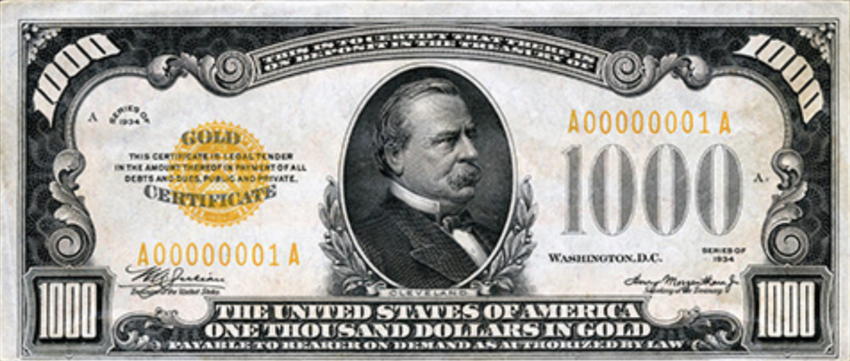
Gabriella writes: I have a Federal Reserve Note of 1,000 dollar bill, series of 1934A with a green stamp. Cleveland portrait on the front and the phrase: “One Thousand Dollars” appears on the back. I wanted to know, how much is it worth and what should I do to exchange it?
1934 Thousand Dollar Bill
$1000 notes are rarely encountered but are still legal tender. Because of their scarcity (and sometimes just to “show off”) collectors and others will pay a premium for them based on their grade (condition).
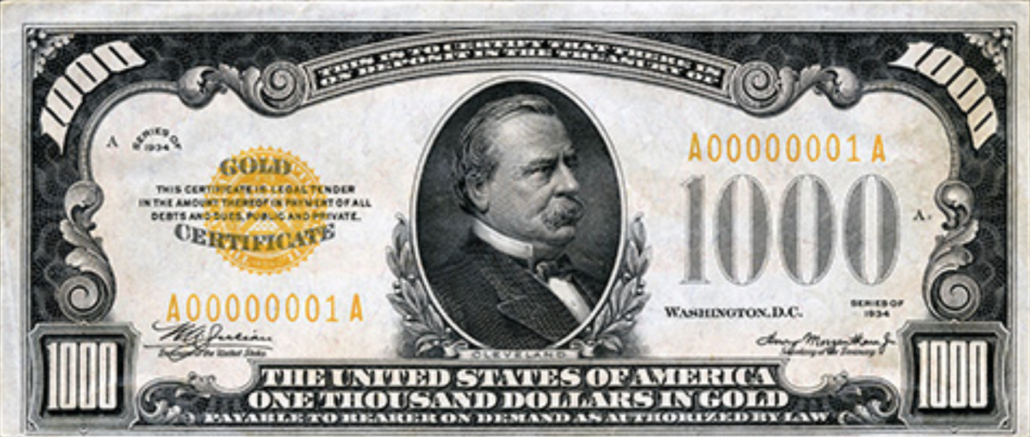
1934 Thousand Dollar Bill
Depending on grade, the approximate value of your thousand dollar bill is $1,400 – $2,000. You can offer the note at your local coin dealer. For another look at the Thousand Dollar Bill, see: Specimen $1000 Federal Reserve Note
Who was the first U.S. President to appear on a silver coin?
Emma W. asks: Who was the first U.S. President to appear on a silver coin?
The first regular issue silver coin that shows a United States President is the 1932 Washington quarter. The first non-circulating silver commemorative coin to show a U.S. President is the 1900 Lafayette Dollar that shows conjoined busts of Washington and Lafayette. This reverse of this coin shows the monument of General Lafayette on horse back that was a gift of the American People to the city of Paris.
1915 “California the Exposition State” medal
John B. writes: I gave a guy three dollars for some interesting coins he had in an old coffee can. One item is a medal, larger than a half dollar, ‘California the exposition state/San Francisco 1915’ on either side, with the “Tower of Jewels” on one side and perhaps the state seal on the other. Reeded edge, tarnished golden color. History, metal composition, mintage amount, suggested value please?
This piece was one of the official exposition “State Dollars” that were minted and sold at the Panama-Pacific International Exposition in 1915. The fair’s purpose was to celebrate the opening of the Panama Canal, commemorate the 400th anniversary of the discovery of the Pacific Ocean and to show the restored city of San Francisco, destroyed by earthquake and fire in 1906. The fair was open from February 20 to December 4, 1915 and had more than 18 million visitors.
It was a large fair with eleven exhibition halls and 240 other buildings. One of the most impressive exhibits was the Tower of Jewels. Thousands of Austrian cut glass “gems” covered a 435 foot tower. Flood lights illuminated the tower; the first use of indirect electric lighting.
Your piece shows a standing female figure facing right, holding a flag of California and a wreath. A bear stands to her left. A view of the exposition is beneath the flag. Above is CALIFORNIA THE EXPOSITION STATE, below, San Francisco 1915. There is a beaded border.
There are several reverses to this medal. Yours shows the “Tower of Jewels” within a circle, CALIFORNIA THE EXPOSITION STATE, below, SAN FRANCISCO.
The medal is gilt brass with a reeded edge. It is not unusual to see the gilt wearing through. Approximate value range (depends on grade): $50 – $300.