U.S. Coins & Currency 447
Who is the “Hendricks” on my 1908 $10 silver certificate?
Michael P. writes: I have found an 1908 $10.00 silver certificate with a person named Hendricks on the face of the bill and blue seals on the front. What is the history of this bill and its value? Thanks.
You have a series 1908 $10 silver certificate (Blue “X” on face). This design is the successor to the 1886 and 1891 series of this note.
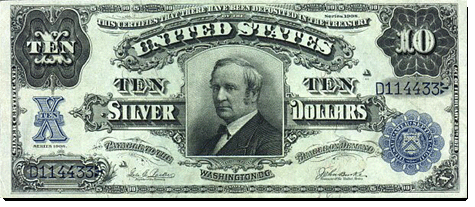
Thomas A. Hendricks was Vice-President of the U.S. in 1865. He is not well known to us as he only held the office for only nine months and passed away November 25, 1865 in Indianapolis where he spent most of his academic and political life. The portrait was engraved by Charles Schlecht. Because of the shape of the border around the portrait, the note is known by collectors as the “Tombstone note”.
Currency is not dated every year like coins but has a series date. The actual date range depends on the signature combinations. There are three signatories for the 1908 series. Vernon-Treat, Vernon-McClung and Parker-Burke.
The condition (grade) of the note is very important in relation to value as competition is greatest for the highest grade examples. Value Range between Fine – Unc: approximately $80 – $2,500.
Nova Constellatio 1000 Mark
Sarah B. asks: Can you tell me anything about the Nova Constellatio 1000 mark? I have a copy I suppose of this unique pattern piece. It has no seams described to me by a couple of dealers, but it does seem to have a slightly porous surface.
The period leading up to the establishment of the U.S. Treasury in 1789 was filled with ideas for establishing the fabric for the new country that became the United States. Gouverneur Morris was the first to propose a decimal coinage (the British system was based on 12 pence to a shilling and 20 shillings to a pound). His ideas were executed by Benjamin Dudley and became the first examples of a pattern coinage for a proposed monetary system. Neither the denominations or the Nova Constellatio coinage were ever adopted but the concept of a decimal coinage stuck.
For the uninitiated, a Pattern is a proposal for coinage. Most patterns are never produced in their original form and are considered a stage in the development of the design. Patterns exist for most United States coinage.
The Nova Constellatio (New Constellation) coins consisted of a copper 5 unit piece, a silver Bit or 100 units, a silver Quint or 500 units (two varieties) and a silver Mark or 1,000 units. All are dated 1783. The 5 unit copper piece is unique (and not known until 1980) but other examples of the other denominations may exist. Few of these coins exist today, in fact all may be unique. Collectors revere the Nova Constellatio patterns for their historic value. Only one 1783, 1000 unit Mark has been sold at auction since 1979. It came from the famous Garrett collection sale and brought $190,000. I’m sure the coin would bring a great deal more today.
There are many sets of electrotype copies that are often found in collections. These replicas have no monetary value. If you believe you may have genuine examples of these coins, you can have them authenticated by one of the major Coin Grading services. See their links on the CoinSite Links page.
What is this California coin with a man panning for gold?
William S. writes: I have found an old coin, unlike any I have seen before. It is the approx. size of a quarter but all I can read on it is, CALIFORNIA on top the year is 1848 and it appears to have a man panning gold while on one knee. Can you please help me identify this coin? Any help would be gratefully accepted.
There are several medals and coins that have a motif of a man panning for gold, including a United States commemorative half dollar minted in 1925 at the San Francisco Mint. The best known of the medal types are the medals issued by the California Medalists Society in San Francisco. The medals were minted at the request of the California State Chamber of Commerce in 1948. Approximately 4000 pieces were minted with 1000 examples gold plated and mounted in a folder.
One example: The obverse shows a miner panning for gold with a log cabin and mountains in the background. The legend around is CENTENNIAL CELEBRATION OF THE DISCOVERY OF GOLD IN CALIFORNIA 1848-1948. The reverse shows a helmeted female, facing left, holding a spear in her right hand. In the background are ships sailing on a bay; there is a bear above. These are quite scarce and probably are worth in the $75+ range in decent grade.
“Filled die” error coin
Joe P. writes: I read about the doubled die coins and other mint mistakes, but what if the coin is missing a part of the date? I have a 199? Lincoln penny. It looks like the die didn’t press hard enough or something. The coin is in very good condition, so the number isn’t worn off. At least there are no signs of major wear on this coin to these eyes. I also have a 1998 penny where the 98 is barely readable. The nine has much more presence than the 8. Again it looks like the die didn’t press hard enough. Would these coins be worth anything one day you think? Thanks.
Your missing digit is a filled die error. Generally, missing digits or mint marks on modern coins are due to filled die errors where dirt, grease or debris fills the recesses of a die not allowing the number or mark to strike up. The metal from the blank can’t flow into that area to receive the impression. This problem usually only lasts for one or two coins until the foreign material falls out of the die.
The coin would be valuable if the die that struck the coin was missing the date digit or a mint mark. That means that others would exist creating a new variety, not unlike a doubled die, where the flaw is in the die and every coin struck from that die shows the same error.
Filled die errors are common and inconsistent and add no value to the coin unless the filled die error is severe.
1849 Pacific Co. $5 gold
Frank S. writes: Do you know anything about a $5.00 coin dated 1849 by a company named Pacific Co.?
Very little is known about this company, one of several that made private issue coins for commerce during the gold rush period in California. The Pacific Company resided in San Francisco but there is nothing known about its origins. It is conjectured that the gold coins with the stamp of the Pacific Company were minted by a firm called Broderick and Kohler (Kohler was the maker of the famous Kohler bar ingots). The Pacific Company gold coins were minted in denominations of $5 and $10. Both are extremely rare. Value range to $150,000. See: Territorial Gold Coins – California Issuers
Massachusetts half cent
Tammy writes: I have a coin dated 1788. One side states “COMMON WEALTH” around the edge with a standing indian holding a bow and arrow. The other side states “MASSACHUSETTS” around the edge with an eagle and shield. The eagle’s wings are spread and each claw is holding something. One claw is holding a branch from a tree, maybe. The other claw is holding wheat possibly. Got any ideas? Thanks!
You have a Massachusetts 1/2 cent or cent. (The half cent is the size of a current US quarter, the cent, nearly the size of a US current half dollar). The obverse of the coin shows an Indian with a star to the left of his head and the words COMMON WEALTH around. The reverse shows a spread eagle with the words either half cent or cent on its breast. This may not be apparent if the coin is severely worn. The eagle is holding a bundle of arrows in one claw (symbol of war or strength) and an olive branch in the other (peace). The legend, MASSACHUSETTS, is around the eagle.
There are many varieties of these interesting coins since all the coins were struck from hand-made dies. For example, the bundle of arrows in the eagle’s claw may appear in either the right or left talon.
The coins were first authorized by the Massachusetts General Court in 1786 and were minted under the direction of Joshua Witherle. The dies for these bronze coins are attributed to Joseph Callender and Jacob Perkins of Newburyport, Massachusetts.
- -This is the first “American” coin struck with the words cent and half cent.
- -The coin was minted in 1787 and 1788
- -The coin ceased production in 1789 to comply with the newly ratified United States Constitution.
Notable:
Value depends on the major type and the grade (condition). Value Range (good -uncirculated): $50 – $3,000+.
Why are the fractional coins of 1851-52 more common than the dollars?
Paul asks: Concerning US silver coinages of 1851 & 1852 – Why are fractional silver denominations so much more common than silver dollars of these dates?
Few silver dollars were made in 1851 (1,300) and 1852 (1,100). The reason centers on the fact that the rising silver prices made the dollar’s silver content equal or exceed the face value of the coin. This was true by early 1853 and was addressed by the Mint Act in February of that year. Secondarily, the coin was not popular as a circulating medium, it was big and heavy and worth too much to be practical in small transactions. Though the coin had been issued from 1840, most were used in the export trade and not as regular currency.
Was the Fugio cent the first coin authorized by Congress?
Constance writes: I’m trying to find out what the first US coinage authorized by congress was. I heard it was copper and said something about “times up – shut up”. Can you help? Thanks a ton.
Times up – shut up? Now there’s an interesting twist of the words that are on the coin. Sounds like the rumor that’s passed around a circle – it’s amazing how different it comes out when it reaches the other end!
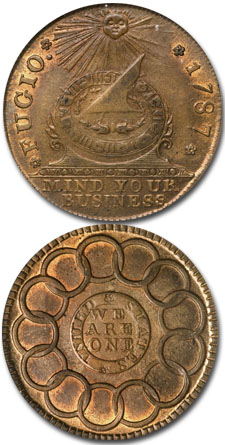
The first coins issued by the authority of the United States were the “Fugio” cents, called so because of the word “FUGIO” on the sun above the sun dial (This Latin legend represents the expression “Time Flies”). Underneath is the words “Mind Your Business”. Fugio Cents were another effort to supply small change for commerce in the fledgling United States.
Note that Fugio cents were coined by a private company in New Haven, Connecticut but other companies might have made them too. Abel Buell was the die sinker. There are many varieties; all are dated 1787. Purportedly, Benjamin Franklin was the author of the legends. The copper is said to have come from the copper bands from powder kegs sent by the French during the Revolution.
The first United States Mint issues weren’t struck until the Philadelphia Mint was built in 1792. The first coins struck were essentially experimental coins and include the 1792 Silver Center Cent, the 1792 Birch Cent and the 1792 half disme (pronounced like the word “steam” but with a “d”).
The first regular issue coins weren’t struck until 1793 and consisted only of the half cent and one cent.