U.S. Coins & Currency 447
1969-S double die Lincoln cent
Bob S.writes: I need help finding information/references regarding the 1969-S double die Lincoln cent. The “Red Book” acknowledges it’s existence but offers little/no help of how many were minted/discovered and values. No one seems to know much about this particular coin and I would be forever grateful for any help/references you can offer.
No one yet has come up with a way to tell how many 1969-S doubled dies exist. When they are found they are usually in grades from VF to Unc. The doubling is strongest on “IN GOD” and at the date.
A doubled die error comes from a defective die set out of many that are made to strike coins each year. Only coins struck from that one particular die set have the doubled image. This type of error appears quite frequently on many U.S. coin dies, especially in the early history of U.S. coinage, though doubling in most cases is barely perceptible. The technology of the times allowed rotation, even if tiny, when the working dies were impressed multiple times.
Collectors are just beginning to discover this coin, but there isn’t yet the recognition that one sees for the 1955 and 1972 doubled dies. Current price records show a range of between $300 -$2,000 depending on grade.
Rutherford B. Hayes Presidential inauguration medal
Ralphal M. writes: Dear Coin Doc: I have a coin with the name of Rutherford B. Hayes and a head on the front of the coin and the back has inaugurated March 5, 1877 and the President of the United States. What could you tell me about this coin?
Your medal (coins have denominations) is an original or copy of the Rutherford B. Hayes Presidential inauguration medal. The dies for this medal were engraved by George T. Morgan of “Morgan Dollar” fame.
Obv: RUTHERFORD B. HAYES around bust to left. MORGAN on truncation. Rev: INAUGURATED MARCH 5. 1877 within a laurel wreath surrounded by the legend: PRESIDENT OF THE UNITED STATES. Size is 76 mm (about 3 inches in diameter).
The original pieces were minted only on copper flans and most examples are seen toned a deep chocolate color. The 20th century Mint copies are struck in a brass alloy, have a “golden” color and are smaller in size than the Mint issues sold to the public in 1878. The Mint brass copies are still available from the Mint catalog.
This medal was the first of the presidential medals marketed and sold to the public. Value Range (originals) $50 – $150 (depending on grade).
California Fractional gold coins
Ray C. writes: I have 4 “California gold” proof coins, dated 1853, 1857, 1859. The 1853 has a octagon shape with Indian head, the 1857 is round with Indian head, and the two 1859 coins have what i think are liberty heads – both are octagon shaped, but are different sized coins. I have been looking for any info related to these coins and so far have not been successful. I would appreciate any help you could provide. Thank you.
The Gold rush period in California (1849-1857) found the inhabitants without sufficient coins for commerce. All that gold and no coins to spend. Ingenuity and great need was the impetus for the creation of the many privately issued gold coins and ingots.
Around 1852 small gold coins with a denomination of a 1/4 dollar, 50 cents and one dollar were produced by jewelers, bankers and others in California to help alleviate the shortage of small change for commerce. These little coins were either shaped round or octagonal but they all stated the denomination on the coin.
The designs were similar to other larger denomination territorial pieces in that the obverse shows a representation of Liberty facing left, sometimes wearing a crown or Indian headdress. Stars are around the bust but not always the traditional 13. The date is below the bust, although on some pieces, it may appear on the reverse. The reverse design shows a wreath, the legend around CALIFORNIA GOLD and the denomination expressed as CENTS, DOL. DOLL. or DOLLAR.
After about 1856, as regular United States coinage began to flow into the area, the acceptability of these pieces declined (they were often debased below their face value) and they became souvenirs or items for jewelry.
The Act of 1864 declared these coins illegal but they were manufactured anyway, at least until 1882. The designs tend to be crude and often incomplete. The later issues were struck on highly polished flans giving them a “proof-like” appearance. There are no proofs.
Genuine pieces have the words CENTS, DOLLAR or an abbreviation of these words on the reverse. There are no bears or other animals on the designs of the original tokens. There are modern reproductions in gold that were sold at the Panama-California Exposition in 1915-16. These have no denomination and are worth a nominal amount.
There were many later issues produced as souvenirs, many struck in low-grade gold or copper with a gold wash. There are also 20th century souvenir versions, some struck in 1917, without denomination and even modern versions with bears minted in brass. These “non-denominated” pieces have nominal value. There are also reproductions in gold plated brass manufactured after about 1950. These are worthless.
Only about 10,000 genuine pieces still exist and more than 500 varieties have been identified, some are very rare. Most pieces show the coin maker’s initials somewhere on the coins. Examples are: N, NR, L, H, G, GG, FD or DERI. Market value depends on the denomination (25c, 50c, 1 dollar), type (round or octagonal) and grade (condition).
For more info, see: U.S. Fractional Gold Coins
A silver Lincoln cent?
Marci M. writes: I have a 1947 silver cent and I was wondering where I might find the value (if any) of this coin.
There were never silver cents minted in the United States. So, what could you have?
1. A cent struck on a dime planchet (blank). A silver dime blank (dimes were silver until 1964) got mixed up with the cent blanks. Since a dime is smaller than a cent, the main characteristic of this error is that the outer parts of the design are missing. In addition, it would weigh only 2.5 grams, instead of the 3.11 gram normal weight of a Lincoln cent of that time (1909-1982). This error is quite scarce. Value Range: $200 -$300.
2. A plated cent. Plating cents or other coins with gold or silver is often used in promotions. The coins are usually given away along with a coupon or other advertising material. The plating gets the attention of the consumer. These have no collector value.
You can confirm that your coin has been plated simply by weighing it on a gram scale and comparing it to the weights above. If your coin weighs 2.5 grams, I strongly recommend that you submit it to one of the grading services for authentication.
1998 Gibraltar 1/10 Royal
Elizabeth B. writes: I have a gold coin(made into a pendant for my necklace). I have not been able to locate any information on it. It has the queen’s head on one side with this writing above it; Elizabeth Gibraltar 1998. On the other side is the upper bodies of two children(with angel wings). One is kissing the other on it’s cheek. Any information you may be able to tell me about this coin will be greatly appreciated. It is slightly smaller than a U.S. dime.
This gold coin was minted for Gibraltar in 1998 in the denomination of 1/10th Royal (probably your coin), 1/2 Royal and 1 Royal. All three coins show Queen Elizabeth II of Great Britain on the obverse and kissing cherubs on the reverse.
These coins are “Non-circulating Legal Tender”, meaning that the coins were made only for bullion, collectors or jewelry, not for currency. The 1/10th Royal contains 1/10th of a troy ounce of gold (3.11 grams pure gold). The coin sells at a premium of approximately 20% above its gold value. There are also similar, larger size versions of this design in a one ounce silver proof and in copper-nickel.
1896 “Bryan Dollar”
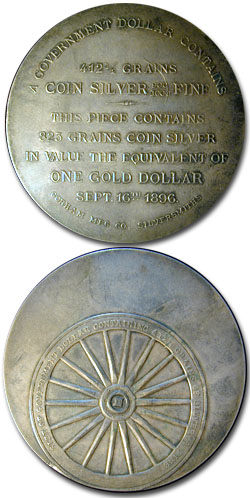
Jim C. writes: Hi Doc, I’ve got a coin that is not currency, but I can’t seem to find any info on. Perhaps you can help. It is slightly larger in diameter than a Morgan silver dollar and it has a picture of a wagon wheel on one side, and the following text on the other. “A government dollar contains 412 1/2 grains coin silver 900/1000 fine. This piece contains 823 grains coin silver in value the equivalent of one gold dollar. Sept 16th 1896. Gorham Mfg Co. Silversmiths” Any ideas? Thanks.
You have a “Bryan Dollar” made for the Presidential campaign of 1896 and 1900. Williams Jennings Bryan ran on a platform demanding parity between gold and silver. The Gorham company pieces were made to illustrate how much silver should be in a dollar to equal the value of gold in a gold dollar. Bryan’s crusade was too late, the country was already heading for a credit system, The Federal Reserve was only thirteen years away. Read about this period in American History to get a better understanding of this medal.
“Bryan money” is popularly collected and are considered an important part of Americana. Besides a three time Presidential candidate, Bryan was also an Evangelist that believed in the literal interpretation of the Bible. He was the prosecutor in the landmark “Scopes Monkey Trial” (Clarence Darrow vs. William Jennings Bryan) in July of 1925 that tried science teacher John T. Scopes for teaching Darwin’s Theory of Evolution in a Tennessee school.
Value Range: $150 – $400 depending on type and grade.
What’s the difference between the Type1 and Type2 Susan B. Anthony dollars?
Todd S. asks: What’s the the difference between the Type1 and Type2 Susan B. Anthony dollars?
The “S” mint mark. Only one punch existed to add the “S” mint mark to the production of proof coin dies. In the late summer of 1979 the punch broke. The punch was just about worn out anyway. Coins struck with dies that had been stamped with the old “S” punch (Type I) had a San Francisco mint mark that looked more like a blob than a letter. A new punch was hurriedly prepared at the Philadelphia Mint and working dies prepared with the new “S” punch have a clear “S” (Type II).
Unfortunately, the new punch was never prepared or annealed properly and by 1981 it too looked like a blob. And so, in 1981 another punch was prepared making two varieties similar to the 1979 proofs, a filled “S” (Type I) and a clear “S” (Type II).
Because both Type II punches were put into service toward the end of the run of proofs for their respective years, there are much smaller numbers of Type II proofs and therefore they bring higher prices when offered in the market.
U.S. Mint set tokens
Chuck writes: I have a coin that looks like a penny. On one side is a shield with scales and a key in it and reads United States Treasury. On the other side is a big “P” and Uncirculated and Philadelphia. There is no date or coin value. What is it?
You have a “Mint Set Token”. This token is struck on a cent blank and is included in United States Mint Sets each year from sometime in the 1980’s to the present. There are two types, one with a “P” which accompanies the Philadelphia Mint coin package of the current year and one with a “D” that accompanies the Denver Mint coin package of the current year. Both of these packages make one Mint set. The tokens themselves have no particular value.
You can purchase current year Mint Sets from the United States Mint.