U.S. Coins & Currency 447
A weird-looking penny that looks like gold
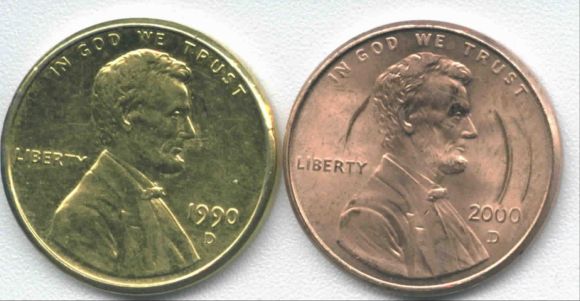
Derek M. writes: My girlfriend brought home a weird-looking penny. It looks like it is made of gold (it is very very yellow), but it isn’t any heavier than a normal penny. It has no minting initial on it. The year is 1990. What gives?
Cents must be the subject of electrolysis students all over the country. The Coin Doc gets lots of questions about silver or gold plated cents. What you have is a plated cent that is commonly used in advertising promotions. Promoters give out gold plated cents because people are attracted to a cent that looks like gold. But there are no gold or silver cents, never were. At 3.11 grams, a cent weighs a tenth of a troy ounce. If the government made them in gold each cent would be worth about $120 at the present gold price!
You can prove that it is really a standard copper and zinc cent by weighing the coin on a gram scale. A standard 1990 cent weighs 2.5 grams. One minted on a gold flan would weigh considerably more than that.
Since gold is so ductile, the value of the plating is nominal. A neat curiosity though!
Wrong coin in my Mint set
Sam F. writes: I have a set of uncirculated US coins from 2 different mints. One of the mint sets has a second penny instead of the kennedy 1/2 dollar. Does this error impact value?
Yes, its worth less. I would have complained to the Mint. They beat you out of the best coin in the set! Packaging errors are fairly common and don’t seem to excite anyone enough to pay a premium for them.
How can I complete my grandfather’s old coin collection
Robert J. writes: I recently received from my grandmother my grandfathers old coin albums with Mercury Head Dime, Lincoln Head Cent, and Buffalo Nickel. Many of these coins are missing and I would like to complete the sets as a remembrance of him. I was wondering if you know of anyone who deals with these specific coins. The albums are from Whiteman Publishing Company from Racine Wisconsin, copyright 1940. The book numbers are 9004, 9008, 9014. Any help you can provide will be appreciated. Thanks Robert
The Whitman albums are still being made and can be purchased at your local coin shop. Most of the coins, in average circulated condition, are available at local coin shops or shows. The hardest and most expensive pieces to find are the early cents like the 1909-S VDB, 1909-S, 1911-D, 1914-D and the 1922 plain. The toughest nickels are the 1913D Type II, 1913-S Type II, 1918-D (8 over 7) and the 1937-D 3 legged nickel. The hardest to find Mercury dimes are the 1916-D and the 1921’s from all mints.
19th century advertising token
Tiffanie S. writes: I have found a coin and would like to know the value of it, if any. On one side it has: 1778 Birth Place of the Declaration of Independence. On the other side: Home of the Philadelphia Record 1899.
The piece you are describing is an 19th century advertising token, common in this period as a way of advertising a store or in this case a newspaper. Many times these tokens had monetary value, very much like product coupons are used today as an incentive to purchase a particular product.
There are many collectors of exonumia. You might want to contact other collectors of tokens and medals if this token has gotten you interested. Try the American Numismatic Association site to request a listing of organizations and dealers dedicated to tokens and medals.
50% off-center strike nickel
G H writes: I have a 1992-p Jefferson nickel that is a 50% off-center strike. The coin would probably be graded better than EF-40. Any thoughts? Thanks.
Coins struck out of the collar such as off center strikes would get stuck in the Mint’s counting machines so relatively few of these errors got out. In recent times the coins are weighed in bags so most of these errors find their way to banks where savvy tellers find them and sell them to dealers or other collectors. Value for your coin about $5-$10.
1776 New Hampshire Copper
Zack W. writes: I have a 1776 New Hampshire Copper coin, with the WM initials on the back. I think it is worth quite a bit of money. Could you tell me about this coin? Also, is there a way you could tell if it is authentic? Thanks.
In 1776 William Moulton was commissioned by the New Hampshire State House of Representatives to make copper patterns for a proposed state coinage. The pattern most known shows a Pine Tree on the obverse and a harp on the reverse Recent auction prices to $13,000. (Stickney/Ellsworth/Garrett coin). The initials WM stands for William Moulton.
Other patterns include a hand engraved piece and a piece with the large initials WM on the reverse. These pieces may not be the work of Moulton.
Very few of these New Hampshire copper cast patterns survived. They are notoriously counterfeited and must be authenticated by a knowledgeable organization such as the Professional Coin Grading Service (PCGS) or the Numismatic Guaranty Corporation (NGC). Genuine pieces are very valuable.
1863 3c Fractional Currency
Neil writes: My friend has had a piece of paper money given to him. It is marked “3 cent act of March 3rd 1863 Furnished only by The Assistant Treasurers & Designated Depositaries of The United States” Any idea of worth? Thanks..
Few people today know that during the Civil War period and for years after the United States issued fractional currency. Fractional currency took the place of coins that rapidly disappeared from the flow of commerce as their intrinsic metal value exceeded face value. The note that your friend has was really issued between 1864 and 1869 and was part of the third issue. The date at the top of the note was the date of the original law. Fractionals are very popular with U.S. paper money collectors and a average example would bring about $15 in the current market. Uncirculated notes are heavily in demand and ones in this condition would bring $50 and more.
Large and small motto 1864 United States Two Cent Pieces
Tammy writes: How can you tell a “large” leaf civil war two penny from a small leaf one. The pictures look alike to us. How much is it worth. Thanks.
I think you are talking about the large and small motto United States Two Cent piece. The two cent piece made its debut in 1864 during the darkest time of the Civil War. It is the first United States coin to use the motto “In God We Trust”. When the coin was first issued the lettering in the legend was too small for the design and was enlarged in the same year and for all subsequent years. Here are some ways to tell the difference:
- Look at the “T” in trust. On the small motto, the “T” is very close to the crease of the ribbon. On the large motto the “T” is about 1mm from the crease.
- The “OD” in God are widely spaced on the small motto, the base of the “O” and “D” almost touch on the large motto.
- The shape of the “O” in God is round in the small motto and oval in the large motto.
- The leaf stem shows plainly on the small motto but doesn’t exist on the large motto.
The value depends on the state of preservation. Uncleaned average circulated Small Motto 2c coins range from $150-$300. Uncirculated, that means new, pieces are worth much more. Circulated Large Motto pieces are worth from $8-$15.