U.S. Coins & Currency 447
“Struck-thru” error nickel
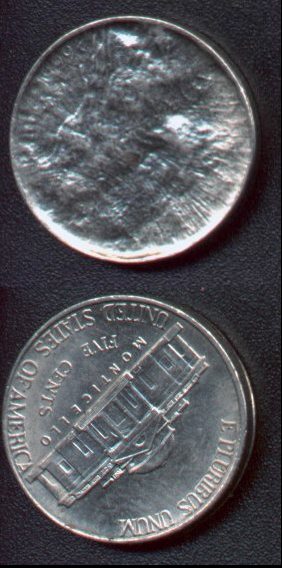
Kathy writes: Here is the scan of the nickel that I have. It appears to be struck too hard at the mint or the die failed. the back side of the nickel is perfect and the coin appears to be in unsurculated condition, as I got it from the bank. It appears to have been minted in 1999. there is no corrosion or tool marks on it. If you could can you give me an approximate value of the coin.
This coin looks as if it is a “struck-thru” error. That is, some object, usually cloth from a die cleaning rag, came between the die and the planchet (the blank). The affected side has little or no detail since the cloth filled the recesses of the die.
Struck-thru errors on Jefferson nickels are in demand by error collectors and bring approximately $50 when offered for sale.
What coin do American collectors call the “silly head” coin?
Cheryl asks: What coin do American collectors call the “silly head” coin?
The term “Silly Head” refers to a particular die variety of U.S. 1839 large cent that includes a browlock at Liberty’s forehead. Other varieties of this date include the “Booby Head” and the “Petite head”.
Mom won a 1992 Olympic silver dollar in a raffle
Leanne E. writes: My mother won a 1992 Olympic Silver Dollar through a raffle. It was donated by a local bank. It is in mint condition and came in a red velvet box. They told her that shortly after they stopped producing this coin it’s value was up to $200. She is curious what the value of it is now.
1992 U.S. Olympic Silver Dollars show a baseball pitcher in action, the reverse shows the Olympic rings, olive branches and stars and stripes. The obverse was designed by John R. Deecken and the reverse was designed by Marcel Jovine. They were struck on .900 fine silver planchets, weigh 26.73 grams and contain .77355 of a troy ounce of pure silver.
There are two versions. The uncirculated piece, minted at the Denver, Colorado Mint (“D” mint mark) has the phrase XXV OLYMPIAD impressed four times around the edge on a reeded background. The proof issue was struck in San Francisco and has mirror fields and frosted devices and an “S” mint mark and was struck multiple times, creating a higher design relief than the uncirculated version. Both of issues are “non-circulating legal tender”, meaning that they were made for collectors by subscription and not for general circulation as money. Though they can be spent for their face value of $1, their collector value and metal content value is higher.
There were 187,552 uncirculated pieces struck – retail value is approximately $40. The proof issue has a mintage of 504,505 and is sold in the retail market for about $35.
Las Vegas dollar
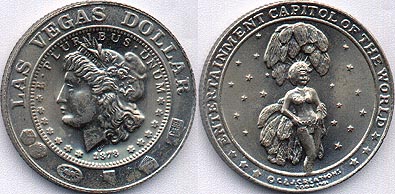
Andrew S. writes: “I have a coin that is a Las Vegas dollar. It has the year 1878, a showgirl on one side and a side view of a lady’s head on the other. There is no casino name on it. Where is it from, and does it have any value?”
This is a modern medal issued by, possibly issued by the Las Vegas Chamber of Commerce(?). You supplied the copyright data on the coin as “C&J Creations, Copyright 1981”.
The token shows the obverse design of a Morgan Dollar made to look like it is inset into the center of the token. The date 1878 is the first year of issue of the Morgan Dollar (1878-1904, 1921). Las Vegas, as we know it, didn’t exist until the 1940’s.
Though there are plenty of collectors for exonumia. I doubt that this piece would bring more than a dollar or two in bronze and maybe a bit more than melt value in silver.
1931 International Harvester Centennial of the Reaper medal
Amy writes: I have a Cyrus-Hall-McCormick 1809-1884 Inventer of the Reaper coin. That is on the front of the coin along with a man’s face with a beard. On the back-the print says International Harvester company Centennial of the Reaper 1831-1931-. There is a man on a horse pulling a plow and a man in back of the plow. I would like some info on this coin.
This bronze medal was sponsored by the International Harvester Company in 1931 to celebrate the 100th anniversary of the invention of the reaper by Cyrus McCormick in 1831. This was the first mechanized agriculture tool and it inspired the invention of many other important farm tools and equipment.
The formal centennial celebrations were held at Walnut Grove Farm, Virginia in July of 1931. Other celebrations were held in 50 U.S. cities where International Harvester operated. International celebrations continued over that year. This was the official medal and was struck by Medallic Art Co. for IHC. 25,000 pieces were struck and were not sold but given as gifts or souvenirs.
The obverse shows a portrait partially facing left of the inventor, the legend around is: CYRUS HALL McCORMICK. To left: 1809-1884 and to right: INVENTOR OF THE REAPER.
The reverse shows two men, one mounted, using a horse-drawn reaper, proceeding to right. Around, INTERNATIONAL HARVESTER COMPANY and below the Reaper, on a shield, CENTENNIAL OF THE REAPER. There are two crossed wheat straws between 1831 and 1931.
These medals are quite scarce today in choice uncirculated condition. Estimated value: $60 -$125.
Is an “irradiated dime” dangerous and what does it mean?
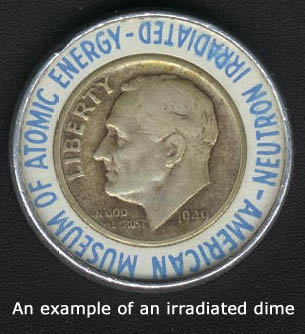
Fred H. writes: My father recently gave me a 1953 Roosevelt Dime encapsulated in a metal (I think aluminum) with a plastic cover. Around the inside of the capsule are the words:
ORNL-CCCC-OAK RIDGE
NEUTRON IRRADIATED
My question is simple: Is it dangerous and what does it mean?
Back in the days of atomic ignorance, radiation and atomic energy were portrayed as harmless and fun. Those were the days when shoe stores had an x-ray machine called a Fluoroscope equipped with viewers so that you could see how the shoes fit your feet. Those were gone when it was discovered that these devices, cute as they were, were toasting little kids.
The encased irradiated dimes were another example of “radiation fun”, though these are not dangerous to people, they are collectors items and are mildly dangerous to your wallet if you decide you want to collect them.
What Americans were on coins that were not presidents?
Michelle writes: Who were the only two Americans to appear on a U.S. coin who were not presidents?
It was public policy not to put portraits of real people on U.S. coins. That ended with the Columbian Exposition half dollar in 1892 which featured Christopher Columbus. The first American to appear on a U.S. coin was Abraham Lincoln, on the cent in 1909. As far as Americans that were never elected president of the United States that also appear on U.S.coins, there are many.
Here are a few:
- Susan B. Anthony dollar (1979-1999)
- Benjamin Franklin graced the half dollar from 1948-63
- William Wyatt Bibb, first governor of Alabama and T.E. Kelly – on the Alabama Centennial half dollar (1921)
- General McClellan and Lee on the Battle of Antietam half dollar (1937)
- Daniel Boone on the 1934-38 Daniel Boone Bicentennial half dollar
- P.T. Barnum on the Bridgeport half dollar (1936)
- George Washington Carver and Booker T. Washington on the 1951 Carver-Washington half dollar
- Stephen Foster on the Cincinnati Music Center half dollar (1936)
- Moses Cleveland on the Cleveland Great Lakes Exposition half dollar
- Captain James Cook on the Hawaiian Sesquicentennial half dollar of 1928
- Senator Carter Glass, former Secretary of the Treasury on the Lynchburg Virginia Sesquicentennial half dollar
- Senator Joseph T. Robinson on the Arkansas Centennial half dollar (1936)
- Stonewall Jackson and Robert E. Lee on the Stone Mountain Memorial half dollar (1925)
- Dr. John McLoughlin on the Fort Vancouver Centennial half dollar (1925)
- Lewis and Clark dollar (1904)
How important are the Population reports?
Reed C. writes: How important are the grading services’ Population reports? I hear more and more about low “pop” coins. Everybody talks about “what’s the pop?” Are mintage figures now meaningless?
Population reports can be suspect and should be used with discretion when purchasing coins. They’re best employed only as a reference. The reports only show the number of coins in a specific grade. They do not report how many time the same coin might have been graded. Though the grading services ask that the inserts be returned if a slab is opened, this is often not done. In the case of some extremely rare pieces, there are more graded than actually exist.
The reverse can also be true. I once observed a telemarketing company sending in large numbers of different dated low grade $5 and $10 Liberty gold coins for grading, the kind that dealers pay around melt or a bit more for. They then touted these PCGS graded common date U.S. gold coins as rare and referred to the population report as evidence of this fact. The truth is that rarely does one send coins in for grading where the coin’s value is close to melt value, unless it is for the above sales pitch.
Some inexperienced collectors paid large premiums for low grade gold because that coin was the “only one graded”. A common date VG $5 Liberty is still just worth melt whether it is in a slab or not, even if it is the only one graded.