U.S. Coins & Currency 447
1896 Martha & George Washington “Educational” $1 silver certificate
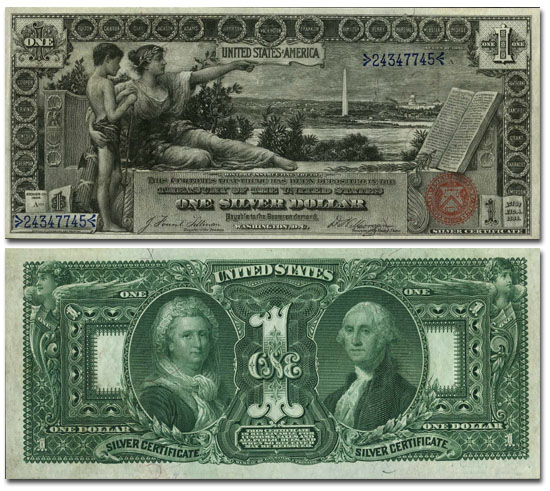
Steve C. writes: I have a dollar silver certificate with Martha and George Washington with a series date of 1896 in average condition. What is the value of this certificate? Thanks
This note is part of the beautiful but short lived “Educational” series that only lasted from 1896-98. The face shows “History instructing Youth”, actually a reclining female figure with her arm around a small boy pointing to the Capitol and the Washington Monument. A picture of the Constitution is at right with the names of famous Americans on the top and side borders. The back shows Martha Washington to the left, George Washington to the right and a large number “1” in the center.
Legend says people objected to the design because no one (“1” ) should stand between George and Martha Washington. (Boo) Scarce and in demand even in average circulated condition. $100+ even for average (no tears) notes, much higher for VF and above grades.
Fractional gold coins or just tokens?
Andrew S. writes: I’ve got several gold coins that are extremely small. Three are octagonal in shape. One of these has an indian head with 13 stars dated 1852 on one side and the words “California gold,” a picture of a bear and 1/2 on the other. The other two have 13 stars, the bust of a man with curly hair wearing a hat, one dated 1855, the other dated 1853. The other side of the smaller 1853 coin only has one star and “California gold” on it. The other three coins are round in shape, two with the indian head and one with the bust of a man in a helmet. The indian head coins each have 13 stars, one dated 1856, the other dated 1854. The 1854 coin has 1/2, a bear and “California gold” on the back. The 1856 coin, smaller in size, shows 1/4 and “Calif. gold” The coin with the man in a helmet has “eureka” above it with 12 stars on one side and “California gold,” a small bear and flowers on the bottom. These coins were left to me by an uncle and I’ve been wondering for years if they have any real value. An extreme thank you for any help! Andrew
None of the original California gold coins have bears as a design device. Your tokens are modern replicas. Though most are brass or gold plated and some are minted in 9 Karat gold, their numismatic value is nil.
All of the small California gold coins that are contemporary with their dates were minted between 1852-56 and were privately made by jewelers. The purpose of these coins was to alleviate the acute coin shortage, especially of small change that existed in the “Gold Rush” era in California. The coins were slightly underweight in relation to their face value. This fact was ignored since the need was so great and the alternative was to use unreliable gold dust.
Nearly all the 1852-56 coins are signed by the makers by an initial punched into the die. They come in 1/4, 1/2 and 1 dollar denomination which are part of the reverse design, usually placed within a circular beaded border. The coins come in octagonal and round shapes.
We know from publications of that time that these small coins were used as money. Later pieces dated from 1859-82 were made by jewelers for the trade and not for use as money, though some of these pieces might have circulated as well. The “souvenir” tokens of 1870 to about 1915 were probably used as money as well as jewelry items. The jeweler’s tokens are valued far less than the issues of 1852-56.
All types of California gold are collected, including the token issues, without denominations, made in the early 20th Century. Don’t confuse these pieces with the modern (c. 1960 or so) brass or 9 Karat gold imitations that plague the unknowing in the numismatic market place. See the following sources:
- Kagin, Donald, Private Gold Coins and Patterns of the United States NY Arco 1981
- Adams, Edgar H., Private Gold Coinage of California 1849-55 Its History and its Issues 1912 (reprinted fairly recently)
- Doering, David and Susan California Fractional Gold, 1980 Santa Monica California
- Kenneth W. Lee California Gold 1979 Kolbe Publications
- Walter Breen and Ron Gillio California Pioneer Fractional Gold, 1983, Pacific Coast Auction Galleries, Santa Barbara, CA.
For more info on the real thing, see: U.S Fractional Gold Coins
Blake & Co. California Gold $20
Jim T. writes: I have found the exact coin (token?) that was described in your pages, “Blake & Co. assayers, 20” in middle; other side “California gold, 20 dolls, s.a.c., smv .900, 1855” with a picture of a press…. Do you have any additional information on this coin? Thank you, Jim
Gorham Blake was a gold dust buyer for Wells Fargo. He went into business with John Agrell, assaying ores and stamping ingots. When Agrell died, Blake continued his business as Blake & Co. Since there were constant coin shortages caused by repeated closings of the San Francisco Branch Mint, Blake thought to make private issue coinage as other similar companies were doing to alleviate the shortage of money. Blake was a little late in beginning and by the time he created his first coins the era of private coinage in California was about over. The government was getting a bit sticky about unofficial coinage, and the coin was never minted. Only a few brass and copper patterns survive today.
The only Blake & Co. piece that I know of minted in Sacramento, is a milled edge pattern struck with the date 1856. It exists in brass and copper and show a Liberty Head to the left surrounded by 13 stars, date below, on the obverse and an eagle on the reverse with a design similar to that on the United State’s Liberty Double Eagle. Around the edge, above, SACRAMENTO CALIFORNIA and below TWENTY D. There also exists a gold-plated specimen that was sold at the McCabe sale sometime in the 1860′s.
This coin is actually a gold ingot with the denomination punched in by hand. Only one Blake and Co $20 gold coin is known to exist. It is in the Eli Lilly collection that is currently housed at the Smithsonian in Washington D.C. As this example is accounted for, your piece is most likely one of the brass copies sold in souvenir shops. The coin that you have may really be a token or even an advertising piece. Tokens such as these were in use in California as gambling markers, at a time when gold dust was the ” coin of the realm”.
If you think it might be genuine you can weigh it. It will weigh 32.9 grams and will be made from .900 fine gold and have a reeded edge. If it passes that test, it’s time to send it to PCGS or NGC for certification.
U.S Trade dollars and “chop marks”
Robert P. writes: When in Indonesia a few years ago, I was approached in Sulewesi by someone who showed me a 1876 Trade Dollar. I bought it because it looked like it could be very valuable. He said that it belonged to his grandmother. I think I paid the equivalent of about 3 or 4 dollars for it. You can clearly see the detail on both sides of the coin, but it is somewhat worn on the high spots. I was just wondering how many were made and how rare a coin like this is?
Now I wish I would have bought the rest of the coins he was selling, but I was a bit worried that they may have been counterfeits. I can see now that they were indeed real. Thanks for your response! Sincerely Robert P., Portland, Oregon.
The purpose of the United States Trade Dollar was to compete in the Orient with other, mostly British, coins used to trade for goods in that part of the world. The coin had more silver than the normal silver dollar (420 grains vs 412.5 grains) so it would match the British coin. It is not unusual to find them in Asia since that is where they were used. However, most of the pieces that did circulate in Asia are found “chop marked”. These are small symbols hand stamped into the coin that represented the mark of a banker and a declaration that the coin was genuine. It is not unusual to find many chop marks on Trade Dollars. Though I find chop marked Trade Dollars fascinating, they are valued less by collectors who are looking for pristine pieces. Genuine 1876 Trade Dollars in average circulated condition bring about $100.
How do I figure how much my 90% silver coins are worth?
Hal A. writes: I read that if silver is $20/oz , 90% silver are worth about 15x’s their face value. My question is when silver goes to $25/oz (or whatever amount), how do I calculate (do the math) to see how much my coins are worth. I hope you can answer this. It is important to me. Thank You Very Much
Pre-1965 90% silver coins are traded in “bag” quantities of $1000 face value. The prices of these units have a bid/ask wholesale price just like any other bullion item. The buy or sell prices are usually a small percentage above or below these prices depending on whether you are buying or selling. Though the bag price is related to the spot silver price, the premium varies with market demand as well as the price of silver futures (one of the sources of the quoted price of silver you hear on the radio).
What does the spot price represent? The quoted silver price is a survey of what 1000 troy oz. Comex deliverable silver bars are trading for in the market – not the price of worn silver dimes or quarters. Interestingly enough, while the coins usually bring a higher price than their silver content, more recently, as silver’s price has fluctuated wildly, the market price for 90% coins has often been at a discount to silver’s spot price
Below is a listing of the silver content of U. S. silver coins that are sold in bag quantities. Multiply the decimal number against the price of silver to get the value of the metal content.
- War Nickels (large mint mark above Monticello 1942-45) – .05626
- Dimes (pre 1965) – .07234
- Quarters (pre 1965) – .18084
- Half Dollars (pre 1965) – .36169
- Half Dollars (1965-70) – .14792
- Silver Dollars (1878-1935) – .77344
See: U.S. Silver Coins: When they ended and what they’re worth.
“1588” on one side and “good for 5c in trade” on the other
Patrice K. asks: I have a coin that has “1588” on one side and “good for 5c in trade” on the other side. (The “c” is the cents symbol.) Unfortunately, a hole has been drilled into the top, for a key chain! Will you please tell me the origin, history and value of this coin?
I’ve seen this token before and I believe the “1588” was the code for a particular store. Collectors are frustrated by this piece because of the lack of origin on the coin. Value: less than $5 for this piece.
“Green River Whiskey” Token
Joann H. asks: I have a coin that I don’t know anything about. It is about the size of a silver dollar. On the front it has a man standing by a horse, it says: GREEN RIVER WHISKIES. THE WHISKEY WITHOUT REGRETS. On the back it says: ITS LUCKY TO DRINK WHISKIES. It has a horse shoe in the middle of it with a 4 leaf clover. It also says: oldetyme distillers inc. N.Y.C. The coin has a goldish color to it. Please help me.
“Green River Whiskey” is the most famous of the 19th Century merchant advertising tokens. Most are a gold colored brass that have a small “nipple” in the center. This type of token is called a spinner in that if you place it on a table, nipple side down, you can spin it like a top. I assume that Green River Whiskey was mild enough so that you could drink it and watch the spinning token too without having to run to the outhouse to deposit your cookies (the regret part).
They can come in nice condition but many suffer from black carbon spots. Value from $5 to $20. depending on condition.
Question regarding strike on a 1923-S Lincoln cent
Steve writes: I got a question regarding a 1923-S Lincoln Cent. I’m thinking of purchasing this coin. The dealer says its a MS64Red Brown. The obverse looks like a 64 with minimal marks. My problem is with the reverse, the penny looks poorly struck. Missing and weak letters in E Pluribus Unum and missing wheat lines. I agree that its a Red Brown – but can this coin still merit a 64 with a reverse in this shape?
The 1923-S Lincoln is scarce in uncirculated grades and rarely comes red. It seems that most of the unc specimens are late die state so it is not unusual to find design problems such as weak devices or lettering. Grading is an opinion of the deterioration of a coin from the time it leaves the dies to when it is in your hands. Technically, weakness of strike is not a consideration. Esthetically it is. I would prefer a nicely struck AU to a weak MS64 on this date.