U.S. Coins & Currency 447
Which U.S. coin denomination is most used?
(Andre B. writes: Hi, My son is trying to find out which coin is most used. Is is the penny, the nickel, the dime, the quarter, or the half dollar? Thank you.
One way to tell the answer to that question would be to look at the mintage figures over a period of time for each of the above denominations. Also, think how the coins are used. Each one has a different or subsidiary purpose.
Except for the half dollar which is not used at all in every day commerce, the order of usage is probably the following:
- The cent (got to pay the sales tax) – mintage in the billions each year
- The dime – change for a quarter. Close or over a billion minted each year.
- Quarters – vending machine fodder, in the billion range
- Nickels – not as useful but just behind quarters.
U.S 1934 twenty dollar bill
Stephanie H. asks: I have a 1934 twenty dollar bill and wondered if it is worth anything….other than face value! Thank you for a reply. Stephanie.
An uncirculated note would bring at least a $10 premium. These notes were made for a long period of time and were replace by the 1950 series of Federal Reserve Notes. A small letter next to the date (A-D) would allow knowing the approximate date range.
Though these notes are not yet valuable, especially if they have been circulated, they are bound to become scarce over the the next ten years as they are replaced by the new $20 design. There are a few characteristics that make some 1934 $20 Federal Reserve Notes more valuable than others. Here’s a few thing to look for:
- Any 1934 or 1934A note overprinted “HAWAII”
- Star Notes, that is notes that have a star next to the serial numbers. They are replacement notes for notes that were destroyed at the Bureau of Engraving.
- In 1948 the White House, that appears on the back of the $20 1934C note, was changed. The new version shows 2 more chimneys, a second floor balcony and different and larger trees and bushes.
- Though not considered valuable yet, the 1934 $20 Minneapolis Federal Reserve note is scarce and has the lowest number printed of all the $20 1934 FRN issues.
- For the 1934A $20 issues, Atlanta FRN (less than 6 million notes printed), Dallas FRN (only about 2.5 million notes printed and the Philadelphia FRN (less than 4 million made) should be put away for a few years. These will be considered scarce or rare in the future.
I bought a U.S. 1848 Seated dollar at a flea market
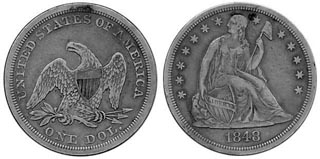
Denis L. writes: I bought this in a flea market, can you tell the value of this silver dollar and which grade it deserves? See the photo attached. Your site very instructive and well done. Thanks a lot. Denis L. Dunham, Québec.
The coin is a U.S. 1848 Seated Liberty dollar and looks like it might be in Very Fine (VF) condition. This is a rare date dollar, only 15,000 were minted. Estimated value between US$450-$550.
Identifying the 1982 Lincoln cent varieties
Jon S. writes: Hi Doc, My six year old son Kyle, just started collecting U.S. pennies. My question is: What is the easy way to tell the differencebetween the 1982 variations… large date, small date, copper zinc? We have found 7 or 8 1982 pennies and they all look alike to us. Any chance of getting a photo telling us what to look for? Thanks, Jon
The 1982 copper plated zinc cents exhibit many bubbles over the surface. You can easily see these bubbles with a 4 or 5 power slide glass. This flaw is caused by the copper plating not adhering properly to the surface of the zinc.
If you have access to a gram scale, copper cents will weigh 3.11 grams and the copper plated zinc cents will weigh 2.5 grams. Proofs were struck in the old copper alloy.
The large date cents have a curled end to the number 2, the small date 2 is almost straight. Also see: Some 1982 cent facts
1776 Continental Dollar Bashlow restrikes
S. R. writes: I found this coin in my yard, can you help me please. I can’t tell if my coin is an original or not. I can tell you that there was a restrike of this coin offered by Robert Bashlow & Company back in the 60’s. The restrikes were made from the original die, and were offered in brass, pewter and silver. The silver ones had an “S” stamped on them. I think mine may be pewter. How much are the restrikes worth if this one is a restrike?
No one is sure exactly how the original Continental Currency dollar-size coins were used but they were probably prototypes for the first United States silver dollar. We know that the coin was designed by “E.G”, possibly Elisha Gallaudet. The coins are marked with E.G. FECIT, Latin for E.G. made it. Original examples are quite valuable.
There are lots of restrikes and replicas of this historic coin, some made for the centennial celebration in 1876, restrikes made by Coin dealer Thomas Elder before WW I, Q. David Bower’s 7200 white-metal restrikes from the Elder dies in 1961, Robert Bashlow’s transfer die imitations, and even some aluminum versions made by the Boys Scouts of America.
Robert Bashlow had a somewhat colorful reputation as both a coin dealer and marketeer. He is widely known in numismatics for restriking the Confederate cent from the defaced Robert Lovett dies in 1961. The Bashlow Continental dollar restrikes in silver, of which 2000 were struck, can be identified by a small s near the rim at 7 o’clock between the Delaware and Pennsylvania links. In addition, 3000 in goldine and 5000 in bronze and “a few trial pieces in various metals” were also struck. Current value $250-$400.
Were any quarters minted for the year 1975?
Joy T. writes: Were any quarters minted for the year 1975. Been searching and cannot fine one.
Quarters, half dollars and dollars were never minted with the date 1975. The Bicentennial design which featured the dual date 1776-1976, was minted for two years to accumulate enough coins to prevent hoarding and give everyone a chance to save some specimens as souvenirs.
Spanish Colonial cobs
Eddy writes: I have some Spanish silver coins from 1535 – first Spanish coins to be minted in the New World for the Spanish Crown – Juana & Philip. I think they are referred to as Cobs. Do you know anything more specific about them? How much are they worth today? Many thanks
Cobs were minted in Mints in Spain and in Mints all over “El Peru”, what we call Latin America, from 1535 – to c. 1760. The shape of the coin and its nick name “cob” comes from the method of manufacture (cabo de barra or end of a bar). A piece of hot gold or silver was cut from the end of an ingot, weighed and struck by hand between a set of dies. After the coin cooled, the coin was then weighed again and adjusted as necessary.
The gold coins were minted in gold in 1/2, 1, 2, 4, and 8 escudos, the silver in 1/2, 1, 2, 4, 8 reales. For hundreds of years the Spanish 8 reales and 8 escudos were the world standard for money. The United States monetary system was based on this standard (8 reales=US$1) and in fact these Spanish coins were legal tender in the U.S. until 1858.
By the 2nd third of the 18th century, the cob style of coinage gave way to the technological improvement of “milled” coinage. Round coinage with a security edge foiled the practice of clipping small pieces from coins, melting the accumulation and then selling the stolen silver or gold.
The Mexico City Mint was the first Spanish Colonial mint in the New World and was established in 1535. The first coins were struck in 1536. The coins from this era were struck under the Spanish rulers Juana y Carlos. You don’t mention which denomination, but only 4, 2, 1 and 1/2 reales in silver were struck at the Mexico City Mint in this era (The first Mexico 8 reales wasn’t minted until 1573).
Coins from this era are almost oval in shape, show the pillars of Hercules with a “4” between (4 Reales), 2 pellets (2 reales), no pellets (1 real). Each of these denominations shows the Spanish Shield with Castles and Lions. The 1/2 real replaces the shield with a crown.
Based on your description the Mint Mark should be Mexico City (M on the earliest coinage and Large M with a small ‘o’ above later). The mint mark was placed to the left of the shield or the crown. There are also assayer marks, mostly single initials, that reflect the person in charge of minting the coins. Cobs are collected by denomination, Ruler, era, mint-mark, assayer and condition. Examples of these early silver coins can bring from $50-$2,500 depending on the above factors.
What’s the price of a 1858 flying eagle one cent in fine?
Tommy P. writes: I need to know the price of a 1858 fine flying eagle one cent piece.
There are three varieties of this coin that are important to collectors:
- 1858 Large Letters – The Letters A and M in AMERICA on the obverse, are connected at their base. Value in the grade Fine – less than $35.
- 1858 Small Letters – the letters A and M in AMERICA are clearly separated. Value in the grade Fine – less than $35.
- 1858 , 8 over 7 – From a 1857 die. The “7” was polished off the die but the top is still visible over the top right of the “8”. Value in the grade Fine about $120.
The emphasis of the Coin Doc’s forum is not so much to price coins as to share information about them. Also, market prices can vary greatly from grade to grade. Other factors come in to play as well. Patina and strike are also important as well as the mint mark. To give you an example, a certain coin in the grade Good, which is a coin with little detail remaining might price at $18 in the market. The same coin in pristine uncirculated condition, lets say MS65, with all the important features struck up might price at $20,000. Not all coins have this extreme range but many do.