
The United States government got into the paper money business by necessity, a way of financing the Civil War through money creation known as fiat money. Congress authorized Legal Tender Notes by the Acts of July 17 and August 5, 1861 (first day of issue). They were colloquially called “Greenbacks” due to their mono-green coloring on the note backs and “Demand Notes” since the first issue notes were redeemable for specie (gold and silver coins) on demand. When specie redemption was suspended on December 21, 1861 the value of these notes began to fall in terms of federal coinage. The public soon accepted the currency on faith that the new U.S. government money would sustain its value in commerce. At the same time, coinage, including copper coins, was rapidly disappearing from circulation.
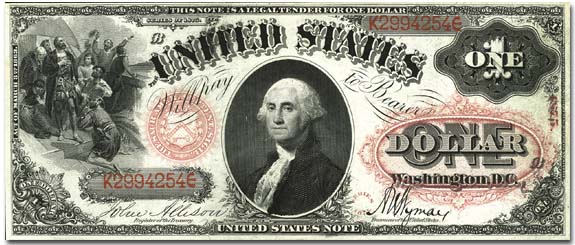
The 2nd issue bears the date March 10, 1862 and is the great-grandfather of the small size legal tender notes with red seals and red Treasury seal that are still occasionally seen today. All bank notes have an obligation that tells the user how the note may be used. The first obligation of Legal Tender notes states “This note is legal tender for all debts, public and private, except for dues on imports and interest on the public debt, and is exchangeable for U.S. six-percent, twenty-year bonds, redeemable at the pleasure of the United States after five years.” This was soon replaced by an obligation sans the reference to bonds, although it was “receivable in payment of all loans to the United States“. The currency was money by government decree.
Though the public looked askance at the new currency, Legal Tender notes continued to be issued in denominations of $1, $5, $10, $20, $50, $100, $500, $1000, $5000 (1878 only) and $10,000 (1878 only) long after the Civil War ended. It wasn’t until 1865 that gold certificates were issued and not until 1886 that redeemable paper money in the form of Silver Certificates, and then later, Coin Notes, were issued. Legal Tender issues continued with their characteristic red Treasury seal and label of “Legal Tender Note” or “United States Note.”
By the 1920’s, the Treasury Department launched a cost saving measure by reducing the physical size of the currency. Legal Tender notes continued to be issued but only in denominations of $1 (series 1928 only), $2 (1928, 1953, 1963), $5 (1928, 1953, 1963) and $100 (series 1966 only). The 1966 $100 note was the last issue of Red Seal notes and was used to satisfy the Act of May 31, 1878 requiring that $346,681,016 of Legal Tender notes always be in circulation. This figure was technically a percentage of all currency types in circulation in 1878. The Act requiring Legal Tender notes was finally discontinued in 1986. Of the small size Red Seals the series $1 note has an interesting history. It was printed in April and May of 1933 but most were released only in Puerto Rico in 1948.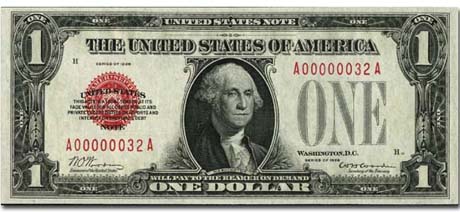
Today there is a dwindling supply of Legal Tender notes in circulation. As they are redeemed for Federal Reserve Notes, the notes are returned to the Treasury for destruction. Only collectors and dealers have preserved these interesting notes for posterity.
Copyright © 2014 Stan Klein & ROKO Design Group, Inc. All rights reserved.
