Truemag

Menu
  • What’s it Worth?
      • US Coin Values WorthU.S. Coin Values
      • 1943-copper-centU.S. Error Coin Values
      • Paper Money Values WorthU.S. Paper Money Values
      • Paper Money Error ValuesU. S. Paper Money Error Values
      • Philippines Coin Values WorthPhilippines Coin Values
    • Close
  • Sell Your Coins
    • Sell Your Coins
    • CoinSite Buyers FAQ
    • Truth in the Coin Shop
    • Should I get my coin collection appraised?
    • Close
  • Gold & Silver
    • U.S. Gold Coins
    • Bullion Gold/Silver
    • Territorial/Fractional Gold
    • Silver
    • U.S. Silver Coins: When They Ended and What They’re Worth
    • Morgan Silver Dollars
    • Close
  • U.S. Coins
    • U.S. Coins & Currency
      • U.S. Cents
      • U.S. Nickels
      • U.S. Dimes, Quarters & Half Dollars
      • U.S. Dollars
      • U.S. Gold Coins
      • Close
    • Exceptional U.S. Coins
    • U.S. Classic Commemoratives & Government Sets
    • History of U.S. Coins
      • The History of U.S. Coins
      • Commemoratives
      • Close
    • United States Paper Money
    • Close
  • World Coins
    • World Coins & Paper Money
    • World Coins – History
    • Selected World Coin Articles
        • North America
          • U.S. Coins & Currency
          • Exceptional U.S. Coins
          • Colonial America
          • Canada
          • Close
        • Europe
          • France
          • Great Britain
          • Spain/ Spanish Colonial/ Latin America
          • Italy/Vatican
          • Germany/Austria
          • Close
        • Australia
        • Asia/Middle East
        • Close
      • Close
    • Close
  • Coin Doc
    • Articles & Opinions
    • Ask the Coin Doc
    • Coin Doc’s Archives
    • Numismatically Speaking
    • General
    • Close
  • Exceptional Coins
    • Exceptional U.S. Coins
    • Close
  • Errors
  • Cleaning Coins
  • Fun Coin Q&A
  • FAQ
    • Frequently Asked Questions
    • Valuing Coins
    • Coin Grading
    • U.S. Gold Coins
    • United States Paper Money
    • Coins in General
    • Resources
1

Obsolete and Unusual Coinage of the 19th Century

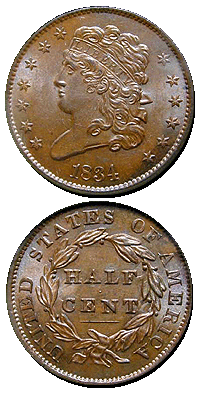
The 19th century in the United States was a period of great change and experimentation in the U.S. coinage System. Many different kinds of coins were tried out. Some coins like the 1/2 cent, became obsolete because of inflation. New kinds of coins were issued because they were thought to be convenient and would aid the flow of commerce. Interestingly, none of these coins were popular or practical enough to survive into the 20th century.

1834-us-half-centThe 2-cent piece, first proposed as early as 1806, finally became an official coin in 1864. The coin is struck in copper and is about the size of a present day quarter. The obverse shows a shield with the date below and the motto “In G-d We Trust” on a ribbon above the shield. The reverse shows a wreath with the denomination “2 CENTS” and around the wreath the words “UNITED STATES OF AMERICA.” It was a short-lived issue with the final date being 1872 for the regular business strikes and 1873 for the proofs. The easiest date to find is the first year, 1864, which in average condition is worth $10 to $12.

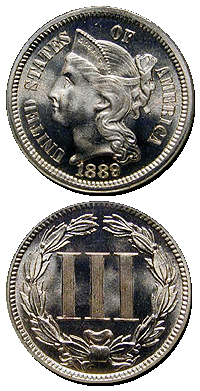
The 3-cent piece was first made in silver in 1851 and was issued as a convenient way of purchasing postage stamps. It exists in three varieties that have the same basic design. It’s a very small coin, smaller than a present day dime, and displays a star on one side and the roman numeral three (III) on the other 1889-3c-nickel-piecethree cent coin made of nickel. This coin shows a head of Liberty on the obverse with a roman numeral three (III) on the reverse. The series ended in 1889. Average circulated pieces are worth about $10.


Half dimes in silver were made in this country from 1794 to 1873. They were eventually replaced by the nickel five-cent piece first minted in 1866. The most commonly found pieces are dated between 1860 and 1873 and these are worth $10 in average1876-20c-piece

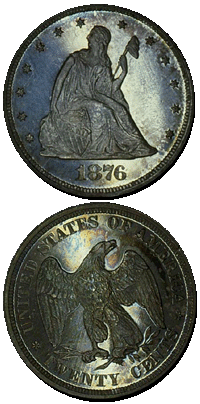
Twenty cent pieces are usually only found with the dates 1875 and 1876 though the coin was made in 1877 and 1878 as proofs for collectors. The coin looks similar to a quarter, with the portrait of Liberty seated on the dated side, and an eagle with outstretched wings on the reverse. It was easy to mistake one for the other even though the twenty cent coin had a plain edge. Average condition common pieces are worth around $70.

Nov 26, 2013coindoc
Why Old Coins Are Not Necessarily ValuableExchanging Money For Money
You Might Also Like
 
1948-63 FRANKLIN HALF DOLLAR
 
1887 British North Borneo cent
coindoc
9 years ago Coins in General0
The Coindoc's MOST POPULAR
  1. U.S. Coin Values
  2. U.S. Error Coin Values
  3. U. S. Paper Money Error Values
  4. U.S. Paper Money Values
  5. About Us
  6. CoinSite Buyers FAQ
  7. Sell Your Coins
  8. Philippines Coin Values
  9. History of U.S. Coins
Menu
  • U.S. Coin Values
  • Sell Coins
  • U.S. Coin History
  • Exceptional Coins
  • FAQ
  • About Us
  • Contact
  • Privacy


2023 © CoinSite