Truemag

Menu
  • What’s it Worth?
      • US Coin Values WorthU.S. Coin Values
      • 1943-copper-centU.S. Error Coin Values
      • Paper Money Values WorthU.S. Paper Money Values
      • Paper Money Error ValuesU. S. Paper Money Error Values
      • Philippines Coin Values WorthPhilippines Coin Values
    • Close
  • Sell Your Coins
    • Sell Your Coins
    • CoinSite Buyers FAQ
    • Truth in the Coin Shop
    • Should I get my coin collection appraised?
    • Close
  • Gold & Silver
    • U.S. Gold Coins
    • Bullion Gold/Silver
    • Territorial/Fractional Gold
    • Silver
    • U.S. Silver Coins: When They Ended and What They’re Worth
    • Morgan Silver Dollars
    • Close
  • U.S. Coins
    • U.S. Coins & Currency
      • U.S. Cents
      • U.S. Nickels
      • U.S. Dimes, Quarters & Half Dollars
      • U.S. Dollars
      • U.S. Gold Coins
      • Close
    • Exceptional U.S. Coins
    • U.S. Classic Commemoratives & Government Sets
    • History of U.S. Coins
      • The History of U.S. Coins
      • Commemoratives
      • Close
    • United States Paper Money
    • Close
  • World Coins
    • World Coins & Paper Money
    • World Coins – History
    • Selected World Coin Articles
        • North America
          • U.S. Coins & Currency
          • Exceptional U.S. Coins
          • Colonial America
          • Canada
          • Close
        • Europe
          • France
          • Great Britain
          • Spain/ Spanish Colonial/ Latin America
          • Italy/Vatican
          • Germany/Austria
          • Close
        • Australia
        • Asia/Middle East
        • Close
      • Close
    • Close
  • Coin Doc
    • Articles & Opinions
    • Ask the Coin Doc
    • Coin Doc’s Archives
    • Numismatically Speaking
    • General
    • Close
  • Exceptional Coins
    • Exceptional U.S. Coins
    • Close
  • Errors
  • Cleaning Coins
  • Fun Coin Q&A
  • FAQ
    • Frequently Asked Questions
    • Valuing Coins
    • Coin Grading
    • U.S. Gold Coins
    • United States Paper Money
    • Coins in General
    • Resources
1

“Hobo” Nickels

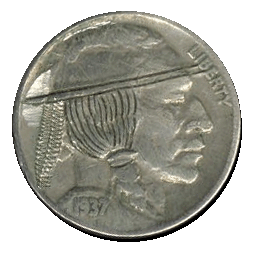
Carved nickels appeared about the same time as the Indian (Buffalo) nickel was issued in 1913. Hobos (not to be confused with bums, tramps or yeggs [see below]), were traveling men who worked for food, shelter or offered services such as lawn or wood cutting or “handy man” type repairs.

For some reason, the Indian’s portrait became an attractive canvas and hobos quickly learned that carved nickels could be traded for a meal a bath or money. The hobo culture was temporarily short lived and many wandering men returned to society during the prosperity of the 1920’s only to return to the hobo life during the depression years of the following decade.

Here are some definitions:

  • Hobo – Wandering, traveling men who worked their way accross the country. Hobos generally followed an unwritten code of ethics and avoided illegal activities.
  • Tramps – Travelling scam artists living off their wits.
  • Bums – Beggers, that usually had no skills; they might be alcoholics and often turned down jobs when they were offered.
  • Yeggs – These were hardened criminals that usually traveled in gangs. Unfortunately, they gave Hobos a bad name.

Carved 1937 Indian (Buffalo) Nickel

1937-hobo-nickel

For more info on Hobo Nickels, see: The Original Hobo Nickel Society


Nov 29, 2013coindoc
All About DimesThe Buffalo Nickel
You Might Also Like
 
Civil War Sutler tokens
 
What’s odd about the 1944 Canadian nickel?
coindoc
9 years ago U.S. Nickels0
The Coindoc's MOST POPULAR
  1. U.S. Coin Values
  2. U.S. Error Coin Values
  3. U. S. Paper Money Error Values
  4. U.S. Paper Money Values
  5. About Us
  6. CoinSite Buyers FAQ
  7. Sell Your Coins
  8. Philippines Coin Values
  9. History of U.S. Coins
Menu
  • U.S. Coin Values
  • Sell Coins
  • U.S. Coin History
  • Exceptional Coins
  • FAQ
  • About Us
  • Contact
  • Privacy


2023 © CoinSite