Truemag

Menu
  • What’s it Worth?
      • US Coin Values WorthU.S. Coin Values
      • 1943-copper-centU.S. Error Coin Values
      • Paper Money Values WorthU.S. Paper Money Values
      • Paper Money Error ValuesU. S. Paper Money Error Values
      • Philippines Coin Values WorthPhilippines Coin Values
    • Close
  • Sell Your Coins
    • Sell Your Coins
    • CoinSite Buyers FAQ
    • Truth in the Coin Shop
    • Should I get my coin collection appraised?
    • Close
  • Gold & Silver
    • U.S. Gold Coins
    • Bullion Gold/Silver
    • Territorial/Fractional Gold
    • Silver
    • U.S. Silver Coins: When They Ended and What They’re Worth
    • Morgan Silver Dollars
    • Close
  • U.S. Coins
    • U.S. Coins & Currency
      • U.S. Cents
      • U.S. Nickels
      • U.S. Dimes, Quarters & Half Dollars
      • U.S. Dollars
      • U.S. Gold Coins
      • Close
    • Exceptional U.S. Coins
    • U.S. Classic Commemoratives & Government Sets
    • History of U.S. Coins
      • The History of U.S. Coins
      • Commemoratives
      • Close
    • United States Paper Money
    • Close
  • World Coins
    • World Coins & Paper Money
    • World Coins – History
    • Selected World Coin Articles
        • North America
          • U.S. Coins & Currency
          • Exceptional U.S. Coins
          • Colonial America
          • Canada
          • Close
        • Europe
          • France
          • Great Britain
          • Spain/ Spanish Colonial/ Latin America
          • Italy/Vatican
          • Germany/Austria
          • Close
        • Australia
        • Asia/Middle East
        • Close
      • Close
    • Close
  • Coin Doc
    • Articles & Opinions
    • Ask the Coin Doc
    • Coin Doc’s Archives
    • Numismatically Speaking
    • General
    • Close
  • Exceptional Coins
    • Exceptional U.S. Coins
    • Close
  • Errors
  • Cleaning Coins
  • Fun Coin Q&A
  • FAQ
    • Frequently Asked Questions
    • Valuing Coins
    • Coin Grading
    • U.S. Gold Coins
    • United States Paper Money
    • Coins in General
    • Resources
1

All About United States Paper Money

Paper money began in the United States in 1861 at the start of the Civil War and was used to supplement the short supply of coins. These notes were supposed to be “emergency money” but this medium of exchange grew to become the dominant and the most popular form of money.

Those early notes were much larger than the notes we use today. Collectors of paper money will sometimes refer to these large size notes as “Horse Blanket” notes. The kind of paper money that we use today are called small size notes. They first appeared in 1928.1896-educational-one-dollar-silver-certificate
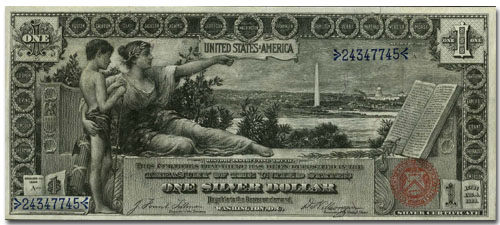
Are the Large Size notes valuable? Well, many people don’t realize this, but these notes are still worth at least face value, and all these notes are worth at least a small premium to a coin and paper money dealer. The premium will depend on the condition of the note. Very worn notes are worth from 5-% to 10% over the face value where notes in new condition can be worth multiples of the face value.
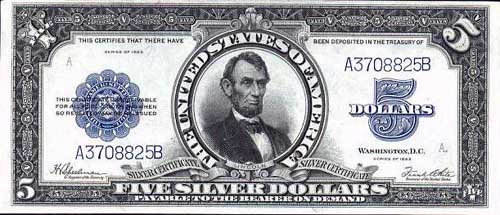

1923-$5-silver-certificate

Are there any valuable small size notes? Yes, there sure are! For instance, the $10 blue seal silver certificate of 1933: This note is rare and is worth several hundred dollars in average condition to $2500 or more in new condition. The 1934 $10 silver certificate with a yellow seal is worth hundreds of dollars in average condition.

When we talk about the condition of these notes, here is what we mean. The following make a note worth less of a premium: Faded color, discoloration or stains, holes, missing corners or pieces, tears, repairs or wrinkles. Notes that are missing these defects are worth much more.

Unlike coins, dates on paper money don’t change every year. The year is only changed if there is an important design change. For example the 1935 series one dollar silver certificate was issued for 28 years until the 1963 series began. Huge quantities of these notes were made over the years. This explains why there are so many notes dated in the 1930’s still in circulation.

Also see: Collecting United States Paper Money

Nov 27, 2013coindoc
Collecting United States Paper MoneyProof Coins & Proof Sets
You Might Also Like
 
Are there different types of 1922 “plain” Lincoln cents?
 
Why do 90% “junk silver” coins have a silver content of only 71%?
coindoc
9 years ago United States Paper Money1
The Coindoc's MOST POPULAR
  1. U.S. Coin Values
  2. U.S. Error Coin Values
  3. U. S. Paper Money Error Values
  4. U.S. Paper Money Values
  5. About Us
  6. CoinSite Buyers FAQ
  7. Sell Your Coins
  8. Philippines Coin Values
  9. History of U.S. Coins
Menu
  • U.S. Coin Values
  • Sell Coins
  • U.S. Coin History
  • Exceptional Coins
  • FAQ
  • About Us
  • Contact
  • Privacy


2023 © CoinSite