Truemag

Menu
  • What’s it Worth?
      • US Coin Values WorthU.S. Coin Values
      • 1943-copper-centU.S. Error Coin Values
      • Paper Money Values WorthU.S. Paper Money Values
      • Paper Money Error ValuesU. S. Paper Money Error Values
      • Philippines Coin Values WorthPhilippines Coin Values
    • Close
  • Sell Your Coins
    • Sell Your Coins
    • CoinSite Buyers FAQ
    • Truth in the Coin Shop
    • Should I get my coin collection appraised?
    • Close
  • Gold & Silver
    • U.S. Gold Coins
    • Bullion Gold/Silver
    • Territorial/Fractional Gold
    • Silver
    • U.S. Silver Coins: When They Ended and What They’re Worth
    • Morgan Silver Dollars
    • Close
  • U.S. Coins
    • U.S. Coins & Currency
      • U.S. Cents
      • U.S. Nickels
      • U.S. Dimes, Quarters & Half Dollars
      • U.S. Dollars
      • U.S. Gold Coins
      • Close
    • Exceptional U.S. Coins
    • U.S. Classic Commemoratives & Government Sets
    • History of U.S. Coins
      • The History of U.S. Coins
      • Commemoratives
      • Close
    • United States Paper Money
    • Close
  • World Coins
    • World Coins & Paper Money
    • World Coins – History
    • Selected World Coin Articles
        • North America
          • U.S. Coins & Currency
          • Exceptional U.S. Coins
          • Colonial America
          • Canada
          • Close
        • Europe
          • France
          • Great Britain
          • Spain/ Spanish Colonial/ Latin America
          • Italy/Vatican
          • Germany/Austria
          • Close
        • Australia
        • Asia/Middle East
        • Close
      • Close
    • Close
  • Coin Doc
    • Articles & Opinions
    • Ask the Coin Doc
    • Coin Doc’s Archives
    • Numismatically Speaking
    • General
    • Close
  • Exceptional Coins
    • Exceptional U.S. Coins
    • Close
  • Errors
  • Cleaning Coins
  • Fun Coin Q&A
  • FAQ
    • Frequently Asked Questions
    • Valuing Coins
    • Coin Grading
    • U.S. Gold Coins
    • United States Paper Money
    • Coins in General
    • Resources
1

1943 U.S. Copper Cent

In 1943 the United States Congress voted to make Lincoln cents out of zinc-coated steel. The country was fighting World War II and copper supplies were needed to make cartridge casings for the war effort.

The steel pennies of 1943 were called silver cents because of their silver grey color. These cents range in color from grey to black because the zinc coating tended to wear off quickly leaving the steel vulnerable to corrosion.

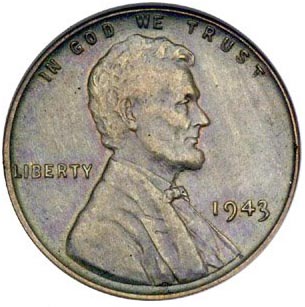
Were any 1943 pennies made of copper? Yes! As we have explained, there shouldn’t have been. An unknown number were made, due to an accident at the mint…1943-copper-cent


To understand how the accident happened, you have to know something about how coins are made. They begin as 10-foot rolls of metal that look like huge paper towel rolls. Coin blanks are cut from these sheets with what looks like a giant cookie cutter. The blanks are then washed and heated and sent through a machine called an Upsetting machine that shapes the edge of each blank, creating the coin rim. Then the blanks are dumped into hoppers that carry them on train tracks to the coin press room. There the hoppers dump the blanks onto a conveyor belt leading to the coin press.

In 1943 mint workers thought they had made sure than no 1942 copper blanks remained in the hoppers. They missed some because 1943 copper cents were later found in circulation. None are known in new condition.

Genuine 1943 copper cents are rare and hard to find, and they can be extremely valuable. In 2010, a 1943-S graded MS62BN sold for a world record price for any U.S. small cent of 1.7 million dollars!

Beware of fakes! Since the 1943 copper cents are so rare they have been a popular target of counterfeiters and other scam artists. Favorite methods of faking the 1943 copper cent include:

  • copper plating a 1943 steel cent.
  • altering the date of a Lincoln cent of another year to make it look like the last digit is a “3” -1948 is a common choice.
  • casting a coin from scratch -very crude and easy to tell, coins are struck not cast.
  • creating a die from a genuine 1943 steel cent and striking a copper flan with it.

If you think you have a 1943 copper cent, how can you tell if it is genuine?

  • Steel cents weigh 2.7 grams, copper cents weigh 3.11 grams.
  • Steel cents are attracted to a magnet, copper cents aren’t.
  • Compare the digits on a 1943 steel cent with your coin. The shape of the digits should be the same and there should not be tooling marks where empty space would be on the”3″.

If your cent passes ALL of the above tests then it is time to get the coin certified by one of the grading services such as NGC or PCGS.


Nov 29, 2013coindoc
1943 Centavo De Cobre1972 Double Die Cent
You Might Also Like
 
American Eagle $50 with “Struck-thru” error
 
1943 3 over 2 Jefferson nickel
coindoc
9 years ago U.S. CentsErrors1
The Coindoc's MOST POPULAR
  1. U.S. Coin Values
  2. U.S. Error Coin Values
  3. U. S. Paper Money Error Values
  4. U.S. Paper Money Values
  5. About Us
  6. CoinSite Buyers FAQ
  7. Sell Your Coins
  8. Philippines Coin Values
  9. History of U.S. Coins
Menu
  • U.S. Coin Values
  • Sell Coins
  • U.S. Coin History
  • Exceptional Coins
  • FAQ
  • About Us
  • Contact
  • Privacy


2023 © CoinSite